Last updated: November 22, 2026
The state of AI in HR in Saudi Arabia is full of momentum. AI is already in most organizations, and the big opportunity now is for HR to own the decision. Today 3% of GCC organizations name HR as an owner of AI adoption, against 59% who name IT or Digital (Korn Ferry, Q1 2026). That leaves HR a wide-open chance to lead. 2027 is a great year for HR to take that seat.
That number is the headline of a new report I wrote as lead author for Solvait Research: State of AI in HR: Saudi Arabia 2027. It’s free and open, in Arabic and English, with no form to fill in. Every figure comes from a public source you can check yourself. No survey was run for it, and no figure is invented.
A plain note before we start. Solvait, my company, sells agentic AI HR software, including an agent that tracks Saudization. The report uses public sources only and recommends no product. I’ll say the same thing in this essay: this is about the numbers, not a pitch.
What does the State of AI in HR report say about Saudi Arabia in 2027?
In short: use is high, readiness has plenty of room to grow, and HR has a clear chance to lead.
The full numbers, each with its source, are on the report page. Here I’ll stay with three. 93% of GCC organizations are exploring, piloting or using AI. 1% are already fully ready to reskill or redeploy their people, so the field is open for leaders. And 3% name HR as an owner of AI adoption (Korn Ferry, Q1 2026).
Read those together and you get a simple picture. Most organizations are already trying AI. The biggest value comes from changing how work gets done, and that’s HR’s home ground.
Who owns AI adoption in GCC organizations today?
Mostly IT, then the CEO. The biggest open seat belongs to HR.
When Korn Ferry asked who owns AI adoption, 59% named IT or Digital and 45% named the CEO or executive committee. 3% named HR. Respondents could name more than one owner, so these don’t add up to 100%. That makes the HR seat one of the most open opportunities in the region.
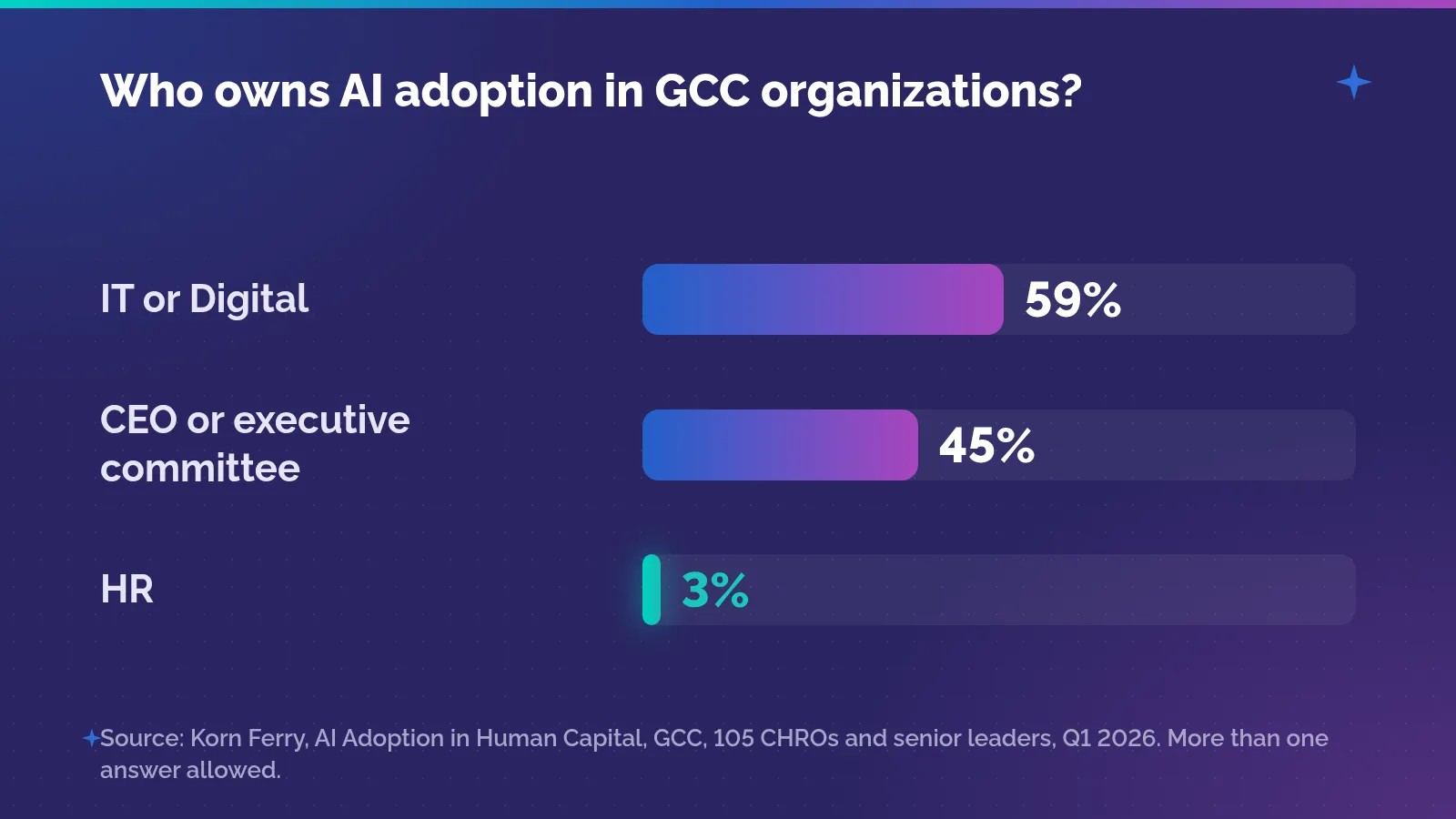
Source: Korn Ferry, AI Adoption in Human Capital: GCC Report 2026, 105 CHROs and senior leaders, Q1 2026. Respondents could name more than one owner.
I don’t think this is anyone’s fault. AI arrived as software, so it went to the people who buy software. That made sense in year one. Now the most important questions about AI are about work, not tools. Who does the first draft. Who checks it. Who answers when it’s wrong. Which roles change, and how fast. Those are HR questions.
And HR is the natural one to answer them.
Why is this HR’s moment to lead?
Because the biggest opportunities the report found are about people, and people are HR’s home ground.
Look at what GCC organizations say stands between them and more value from AI. Integration with current technology leads at 61%. Then talent and skill gaps at 44%, and unclear return at 37%. Employee resistance comes last, at 15% (Korn Ferry, Q1 2026). So the story we often tell, that people are scared of AI, isn’t what organizations themselves report. People are open to AI. The work is in systems and skills.
Now look at readiness. 1% of organizations say they are fully ready to reskill or redeploy their people. 46% are somewhat ready, 23% mostly ready, and 30% not ready yet. And 42% are not hiring for AI roles today. That’s not a technology question. It’s a workforce plan waiting for HR to write it.
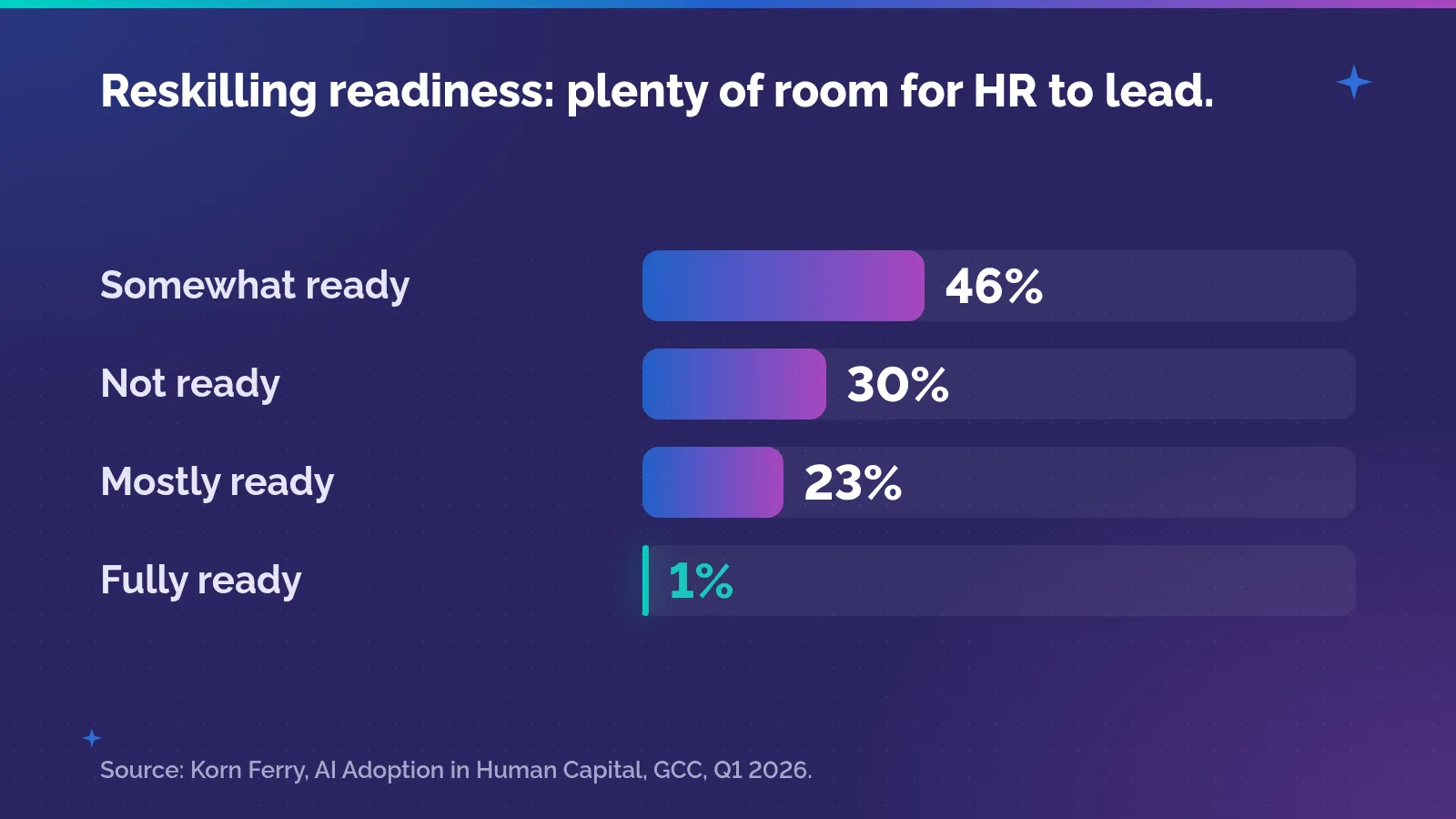
Source: Korn Ferry, AI Adoption in Human Capital: GCC Report 2026, Q1 2026.
Then there’s the employee side. In Saudi Arabia, 69% of employees used AI in their job in the past year, against 54% globally, and 55% expect AI to improve their job security, against 38% globally (PwC Workforce Hopes and Fears 2025). That’s a confident, AI-ready workforce, and a real strength for every employer here.
So we have people who want to use AI, organizations getting ready to move them, and a function that knows how to move people. Put HR in the decision, and those pieces come together.
Isn’t AI adoption an IT job?
Partly, yes. And I want to be fair here.
IT should own the platform, the security, the integration and the data plumbing. Nobody wants HR picking models or running infrastructure. The 61% who name integration as the top barrier are telling us IT has important work of its own.
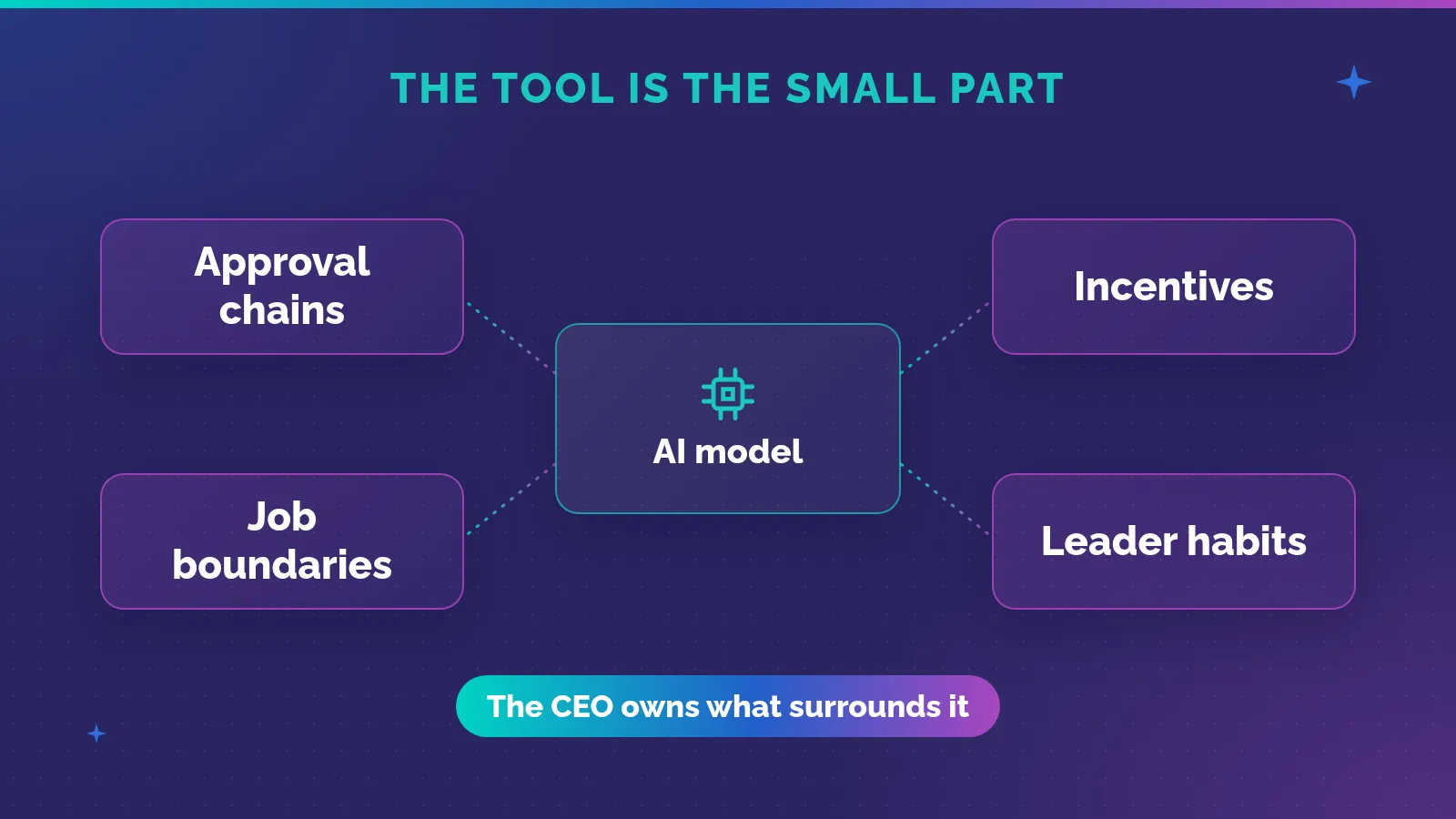
But AI adoption is two jobs, not one. The first is “make the tools work.” The second is “decide how work and people change because of them.” The second job is where most of the value sits, and it’s the one waiting for an owner. HR is the natural fit.
Here’s how I’d split it.
| Decision | Who should own it | Why |
|---|---|---|
| Which platform, model and vendor | IT or Digital | Security, integration and cost are IT’s craft |
| Where AI does the first draft of HR work | HR, with the business | It changes jobs, not just systems |
| Who checks AI output and who answers for it | HR, with legal and the line | Accountability is a people decision |
| How roles, skills and pay change | HR | That’s the workforce plan |
| What employee data AI may touch under PDPL | HR and the data protection lead | Employee data is HR’s data |
| Whether the whole program is worth it | The CEO | Someone has to own the result |
The trade-off is real. Bringing HR in slows the first month down a little. More voices, more questions. I still think it’s worth it, because that’s how pilots turn into value.
McKinsey’s numbers on the GCC show the size of the prize. 84% of organizations use AI in at least one function, and 60% say they use AI agents to some extent, often in early pilots. And 11% are already scaling AI and can attribute at least 5% of earnings to it (McKinsey, 139 executives and board members, Aug to Sep 2025). Use is wide, and the leaders show what’s possible.
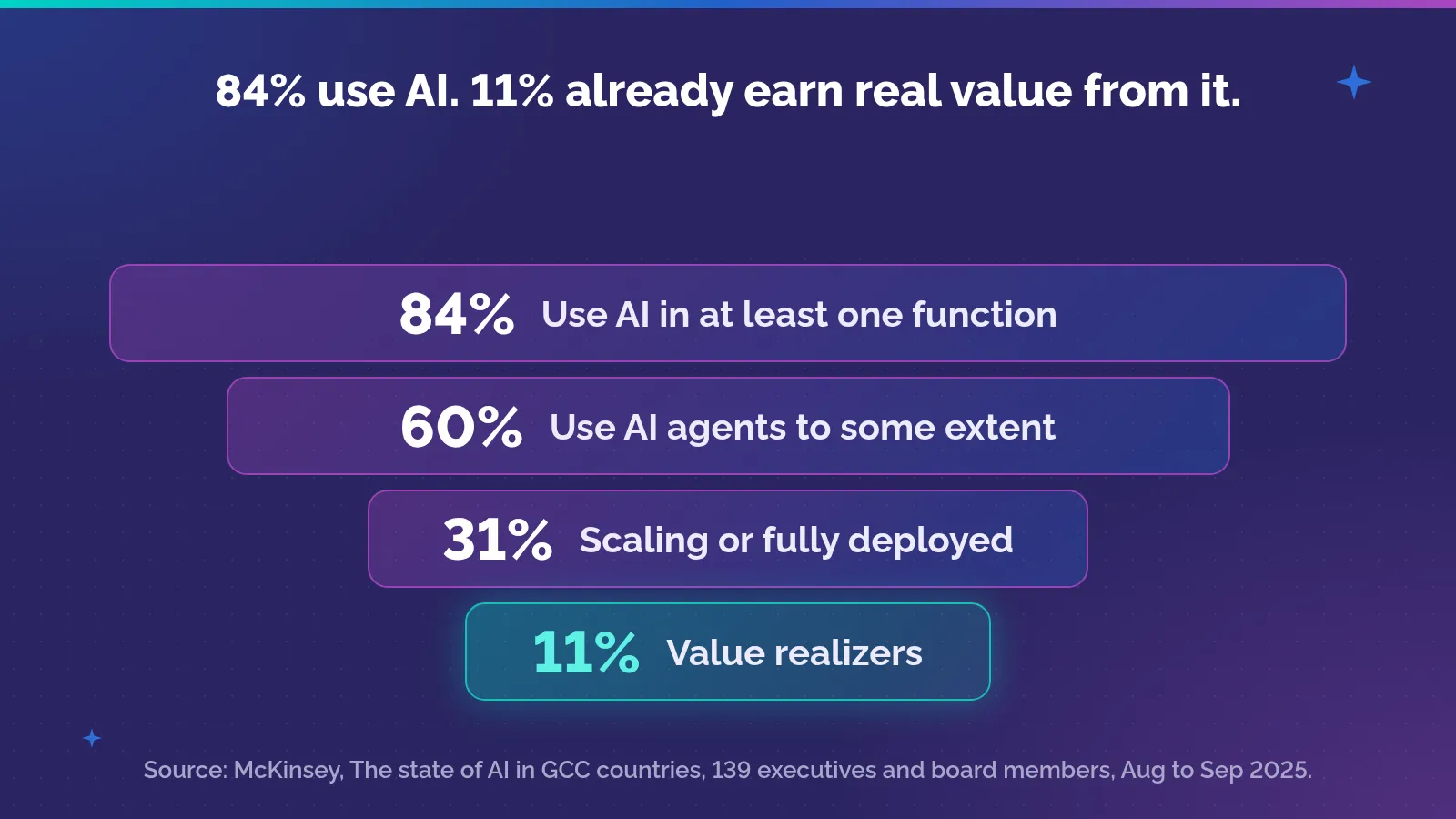
Source: McKinsey, The state of AI in GCC countries, 139 executives and board members, Aug to Sep 2025.
What makes Saudi Arabia different for AI in HR?
The state already built HR’s data rails. That’s a real head start.
Qiwa now holds 2 million+ registered establishments, 13 million+ workers and 12 million+ documented employment contracts (HRSD, Q1 2026). Since 15 April 2026, only Saudi employees whose contracts are documented on Qiwa count toward an establishment’s Nitaqat Saudization rate. In plain words: the core employment record is digital, and it’s the record that counts.
Most countries can’t say that. In my view, it means Saudi HR teams can put AI to work on clean, official data sooner than most of their peers abroad.
There’s also a national job for AI in HR here. Saudi unemployment is 6.5% (Q2 2026), just 1.5 points from the 5% target for 2030 (GASTAT; HRSD). The goal is within reach. Employers operating in Saudi Arabia expect 45% of work tasks to be done mainly by technology by 2030, against 34% globally, and 38% plan to drop degree requirements, against 19% globally (WEF Future of Jobs 2025). So AI in HR here isn’t only about cutting cost. It has to help hire, develop and keep Saudis.
That’s exactly why HR needs to be in the room. Every hiring tool should support the progress the country is making, not only speed. I wrote more on how this changes the HR role in AI is rewriting the HR role in Saudi Arabia.
What should an HR leader do this quarter?
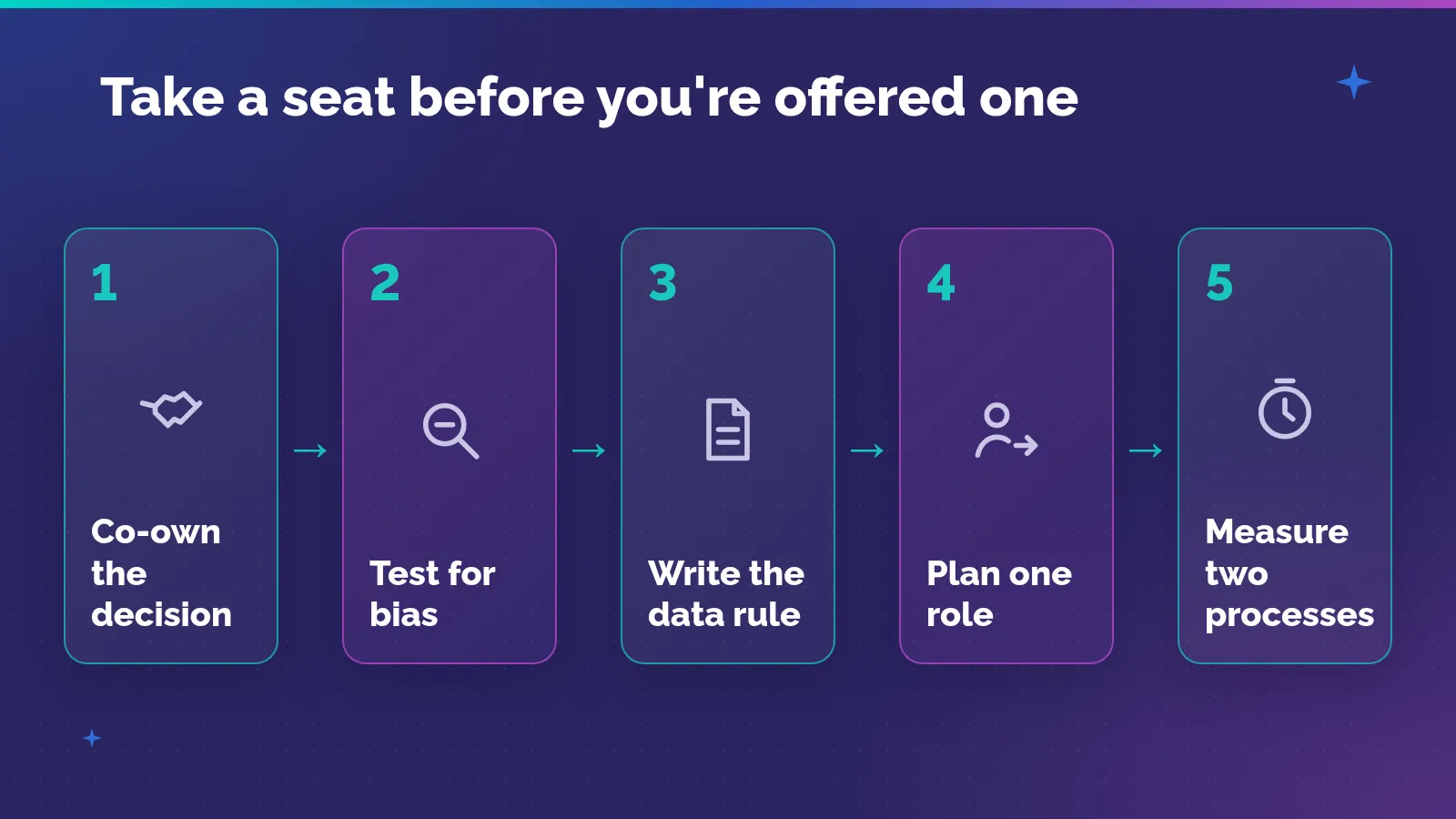
Take a seat before you’re offered one. Here are five moves, each built on a finding in the report.
- Ask your CEO for a co-owner role on AI decisions about work and people. Not the platform. The work. Bring one slide: 3% versus 59%.
- Run a name-swap bias test on your screening tool. Within HR, hiring is where AI is used most, with 50% of GCC organizations using or piloting it there (Korn Ferry). It’s also where bias risk is highest. In a 2024 University of Washington study, AI models favored white-associated names over Black-associated names 85% of the time (US names). Test with Saudi and non-Saudi, male and female, and regional names.
- Write a one-page rule for employee data. Say what never goes into a general AI tool. Biometric attendance data and medical records are the obvious start. PDPL fines go up to SAR 5 million (SDAIA).
- Pick one role AI will change in 2027 and write its reskilling path. With 1% fully ready, one written path puts you among the leaders.
- Measure two HR processes before and after AI. Time, cost and error rate. With 89% of GCC organizations planning to raise AI budgets (McKinsey), proof is what gets HR a seat next year.
None of these need a big budget. They need someone in HR to decide it’s their job.
If you want the bigger picture of where agents fit in Saudi HR, I covered it in agentic AI in HR in Saudi Arabia. And if you’re wondering which HR jobs change most, start with which HR jobs become judgment jobs.
Where can you read the full report?
The full report is free at State of AI in HR: Saudi Arabia 2027. If you want to ask about any number in it, try Ask Amer’s AI, and if you’d like one idea a month on this, the AI HR Newsletter is where I write it. And if your HR team already has a seat at the AI table, I’d honestly love to hear how you got it. Drop me a message.
Frequently asked questions
What is the State of AI in HR: Saudi Arabia 2027 report?
It’s a free, public-data report from Solvait Research, with me as lead author. It covers where AI sits in HR across Saudi Arabia and the GCC, the rules that matter, a readiness self-score and ten predictions for 2027. Every figure comes from a public source, current to 9 November 2026. No survey was run for it.
Where does the 3% figure come from?
From Korn Ferry’s AI Adoption in Human Capital report for the GCC, a survey of 105 CHROs and senior leaders across all six GCC countries in Q1 2026. Asked who owns AI adoption, 59% named IT or Digital, 45% the CEO or executive committee, and 3% HR. Respondents could name more than one owner.
Why should HR, and not only IT, own AI decisions?
Because the biggest opportunities are about people. Korn Ferry found talent and skill gaps cited by 44%, and 1% fully ready to reskill, which is exactly where HR can lead. IT should own the platform. HR should co-own how work, roles, skills and pay change, and who answers for AI output about people.
What can a CHRO do first?
Ask for a co-owner role on AI decisions about work and people, then prove it with one small win. A name-swap bias test on your screening tool, a one-page employee data rule and a before-and-after measure on two processes are all doable this quarter.
Does the report recommend any AI product?
No. Solvait, the publisher, sells agentic AI HR software, and the report says so in a disclosure box. It uses public sources only, ranks no product and recommends none. Figures about Solvait itself are company figures and are not independently audited.
References
- Korn Ferry, AI Adoption in Human Capital: GCC Report 2026, Q1 2026
- McKinsey, The state of AI in GCC countries: In pursuit of scale and value, November 2025
- PwC, Middle East Workforce Hopes and Fears Survey 2025: Saudi Arabia findings, 2025
- GASTAT, Labor Market Statistics Q2 2026, 2026
- HRSD, Qiwa figures, Q1 2026, 10 May 2026
- HRSD, Nitaqat counted on Qiwa-documented contracts from 15 April 2026, 2026
- HRSD, Budget Forum 2025: new target of 5% unemployment among Saudis by 2030, 18 December 2024
- World Economic Forum, Future of Jobs Report 2025: Region, economy and industry insights, January 2025
- SDAIA, Personal Data Protection Law, 2023
- University of Washington, AI tools show biases in ranking job applicants’ names, 31 October 2024
- Solvait Research, State of AI in HR: Saudi Arabia 2027, first edition, November 2026