Last updated: November 11, 2026
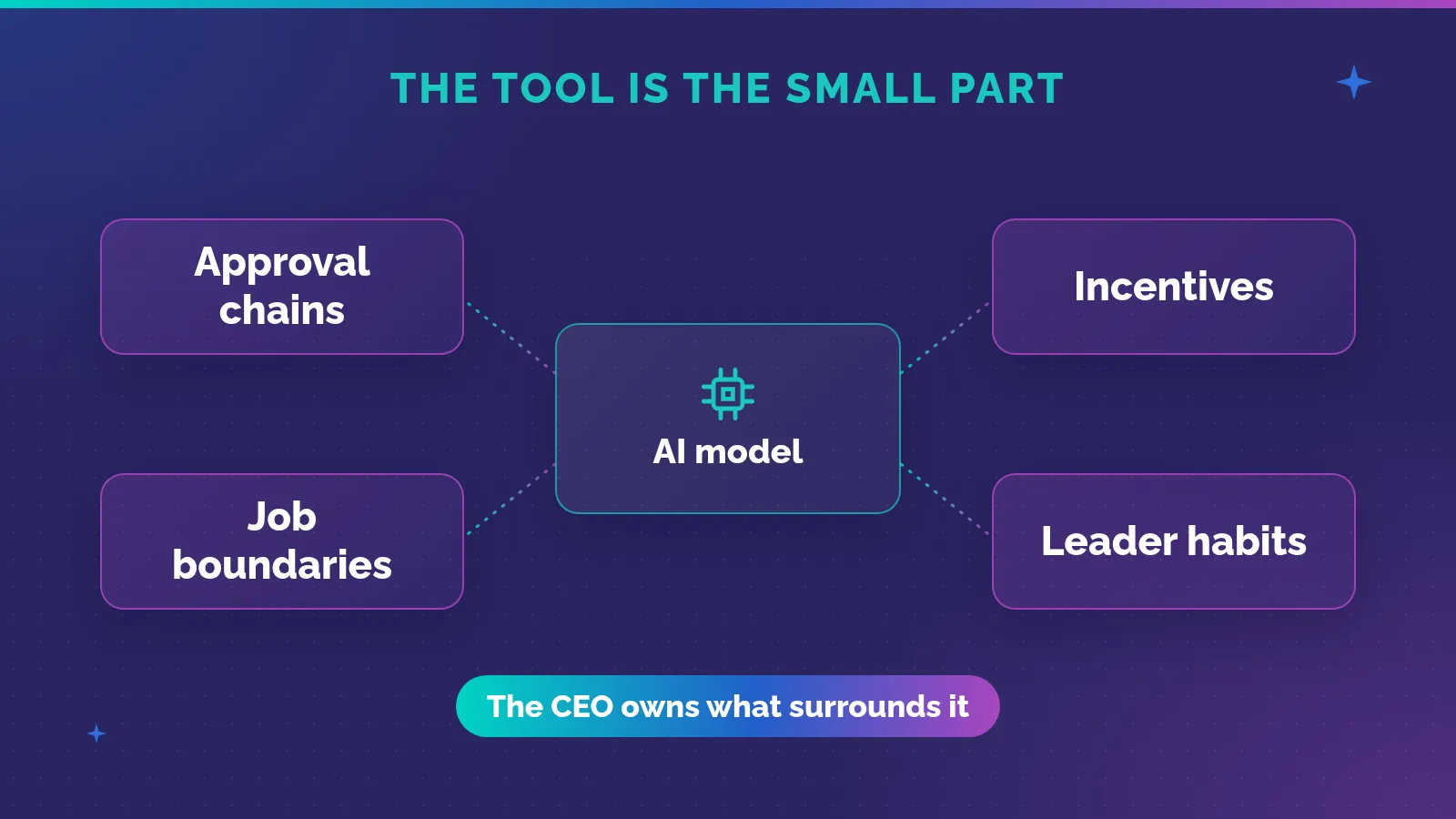
AI transformation leadership is the work a CEO and senior team do to redesign how the organization runs once AI can produce the first output. What resists that work most is rarely the technology. Approval chains, job boundaries, incentives and the leader’s own habits push back harder. No tool, vendor or IT team can change those, so the CEO has to own the redesign personally.
I saw this at Solvait when we moved to AI-assisted coding. What made the switch harder wasn’t a tool. It was our own habits: the set rules about how code should be written, and the way it should be structured inside the codebase.
In The Redesign Imperative, I argued that most companies put AI on top of the old structure and call it progress. I won’t repeat that argument here. This post picks up a question it left open: if the technology isn’t the blocker, what is, and what does a leader actually do about it?
What is AI transformation leadership?
It’s the part of an AI program that only the top of the company can do.
Buying a model, running a pilot and training people on prompts are real work. IT and HR can run them well. But deciding which approval layers disappear, which roles get redrawn and what managers are measured on is a different kind of work. Those are decisions about power, money and people’s sense of their own job. They sit with the CEO and the executive team, or they don’t happen at all.
The numbers say most companies haven’t made that move yet. BCG’s 2024 survey of 1,000 CxOs and senior executives found that 74% of companies have yet to show tangible value from their use of AI. Only 26% have built the capabilities to move beyond proofs of concept and generate real value (BCG, October 2024).
I think that gap is mostly a leadership gap. The 26% didn’t get access to better models than everyone else. They changed more around the models.
What resists change more than the technology?
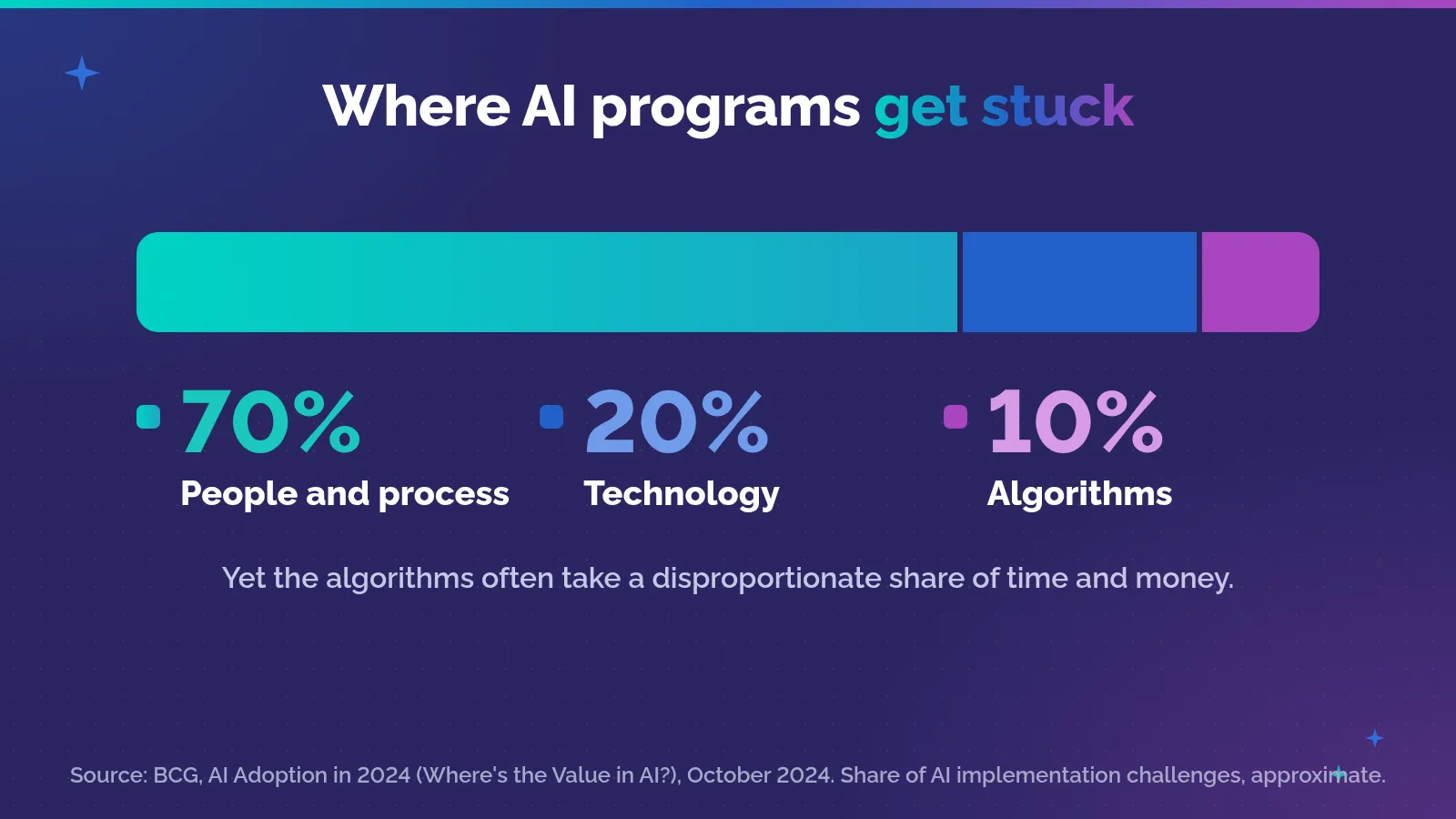
BCG asked the same executives where their AI problems came from. Around 70% of the challenges stemmed from people and process issues. About 20% were technology problems, and only 10% involved the AI algorithms themselves. Yet the algorithms often take a disproportionate share of the organization’s time and money (BCG, October 2024).
That 70% isn’t one thing. In my experience it breaks into four forces, and each one needs a different move from the leader.
| What resists | How it shows up | What the leader has to change |
|---|---|---|
| Approval chains | AI drafts in minutes, then the draft waits days for sign-offs that were added years ago | Remove or merge layers that add no decision |
| Job boundaries | People protect their scope when AI starts doing the first output | Redraw roles in the open and say who owns what |
| Incentives | Managers still gain standing from team size or visible effort | Change what you measure before you change the tool |
| Leader habits | Decks before every decision, every exception escalated, pilots counted as progress | Change your own calendar first |
The rest of this post takes each row in turn.
Why do approval chains outlast every new tool?
Every approval layer was added for a reason. Someone made a costly mistake once, so a sign-off went in to stop it happening again. Years later nobody remembers the mistake, but the sign-off is still there, and now it sits between a draft that took AI four minutes and the person who needs it.
Here’s what makes this hard to fix: leaders often don’t see the chain as the problem. In McKinsey’s 2025 Superagency in the workplace survey, 47% of US C-suite leaders said their organizations were developing and releasing gen AI tools too slowly. Among those, 46% blamed talent skill gaps. Only 8% pointed to complex approval processes (McKinsey, January 2025).
I’d read that 8% carefully. It doesn’t prove approval chains are fine. It may just show that the people who built the chains are the last to notice them.
Only a leader can remove a layer. A manager can’t, and IT certainly can’t. So for each sign-off in a process you care about, ask two plain questions. What decision does this step add? And who would notice if it disappeared? If the honest answer to the second question is “nobody”, you’ve found your first change.
Why do job boundaries push back?
People defend their scope. Their scope is their job security, and often part of who they are at work.
When AI starts producing the first output, the line between “my work” and “the system’s work” moves. Nobody likes their line moving without being asked. And the people closest to the work usually see the change first, which makes them nervous long before the leadership team says anything.
Employers tend to call this a skills problem. In the World Economic Forum’s Future of Jobs Report 2025, 63% of employers cited skills gaps as a main barrier to transforming their business (WEF, January 2025).
Skills matter. But I’d push back a little on that framing. A lot of what looks like a skills gap is really a role-design gap. Nobody has told the payroll specialist that her job is now reviewing exceptions instead of running the calculation, so she keeps doing both, and the AI looks like extra work.
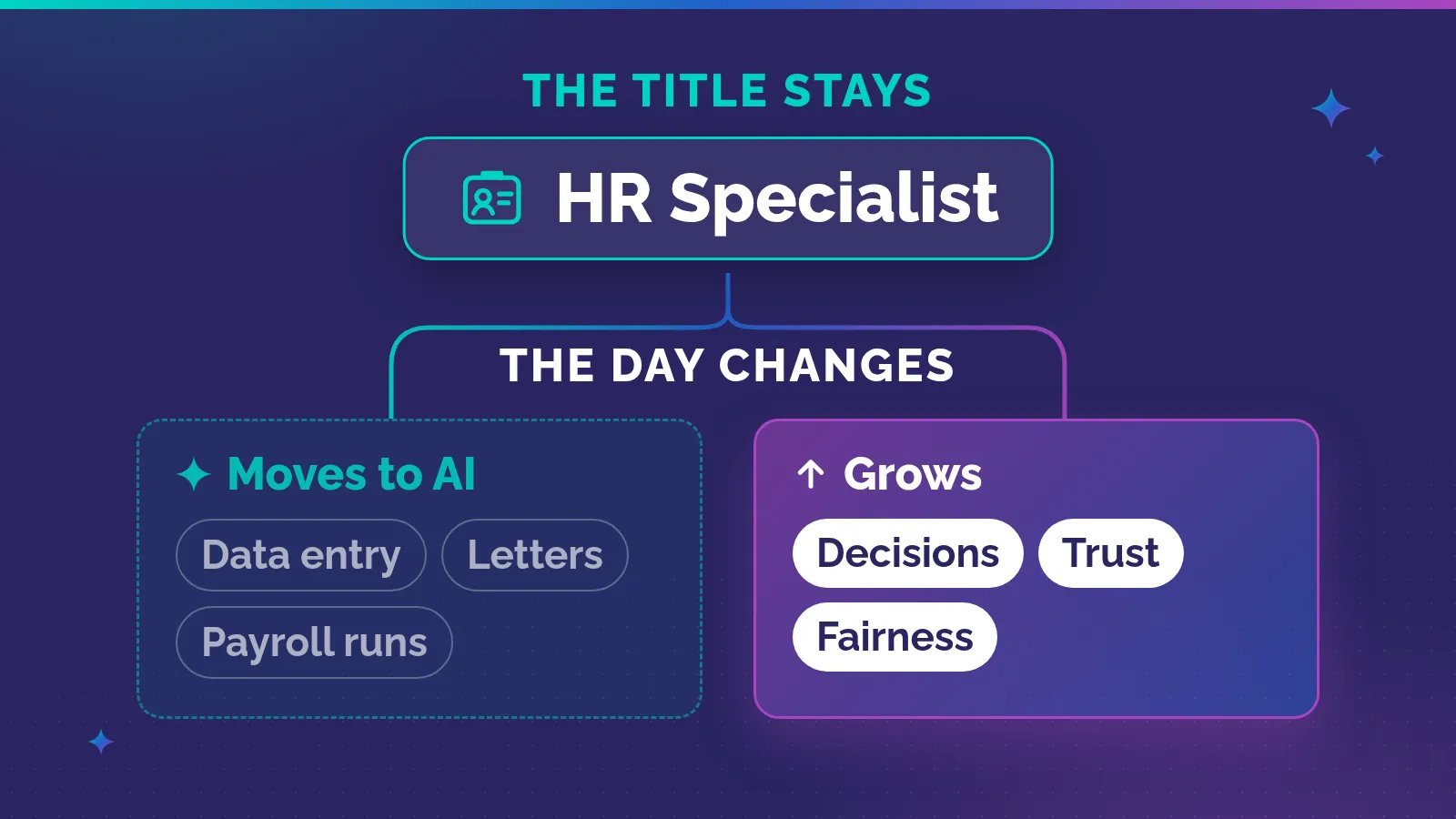
Fixing it takes someone senior. They have to redraw the roles in the open and say what each person now owns. I wrote about how this plays out in HR in Which HR Jobs Become Judgment Jobs When AI Does the Work? The short version: most titles stay, but the day changes.
What do incentives have to do with it?
A lot. People do what they’re measured on.
If a manager’s standing still grows with the size of their team, an agent that does the work of three people feels like a threat. If a department is judged on how busy it looks, nobody will volunteer that half its work could go. And if a team gets more budget every year it hits its targets with more people, you’ve built a machine that rewards hiring around a problem AI could solve.
None of this is bad faith. It’s people reading the system correctly.
So before you buy anything, look at what you actually reward, whether that’s headcount, visible effort or the number of reports produced. Each of those quietly works against the change you say you want. Change one measure for one team, and you’ll learn more about your real resistance in a month than from a year of AI town halls.
Is the leader the biggest blocker?
Often, yes.
McKinsey’s Superagency report surveyed US employees and executives and reached a blunt conclusion: employees are ready for AI, and the biggest barrier to success is leadership. It also found that C-suite leaders were more than twice as likely to say employee readiness is a barrier to adoption as they were to blame their own role (McKinsey, January 2025).
That’s a US survey, so I wouldn’t copy it straight onto Riyadh. But I’d be surprised if the pattern were very different here.
The leader’s habits are the hardest structure to see, because the leader built them. They show up in small things: asking for a deck before every decision, wanting every exception escalated, or counting pilots as progress. Each one makes sense on its own. Together they set the speed limit for the whole company.
To be fair, some checks should stay. Payroll, compliance and anything that touches people’s pay or contracts deserve a second pair of eyes. The aim is that every check you keep exists on purpose, with someone who can say what it protects.
Who should be in the room when AI strategy is set?
More people than usually are. And HR is the one most often missing.
IBM’s 2026 CHRO study surveyed 1,500 CHROs and 8,800 employees. It found that 46% of organizations don’t involve the CHRO when AI strategy is being defined. And 73% of CHROs said they struggle to coordinate consistently across the C-suite. Only 28% of CHROs report a joint roadmap with IT backed by a shared operating cadence (IBM Institute for Business Value, September 2026).
Think about what that means. Three of the four forces in the table above (job boundaries, incentives and much of the approval chain) are people questions. If the person who runs people isn’t in the room, the strategy is being written without the part that resists it most.
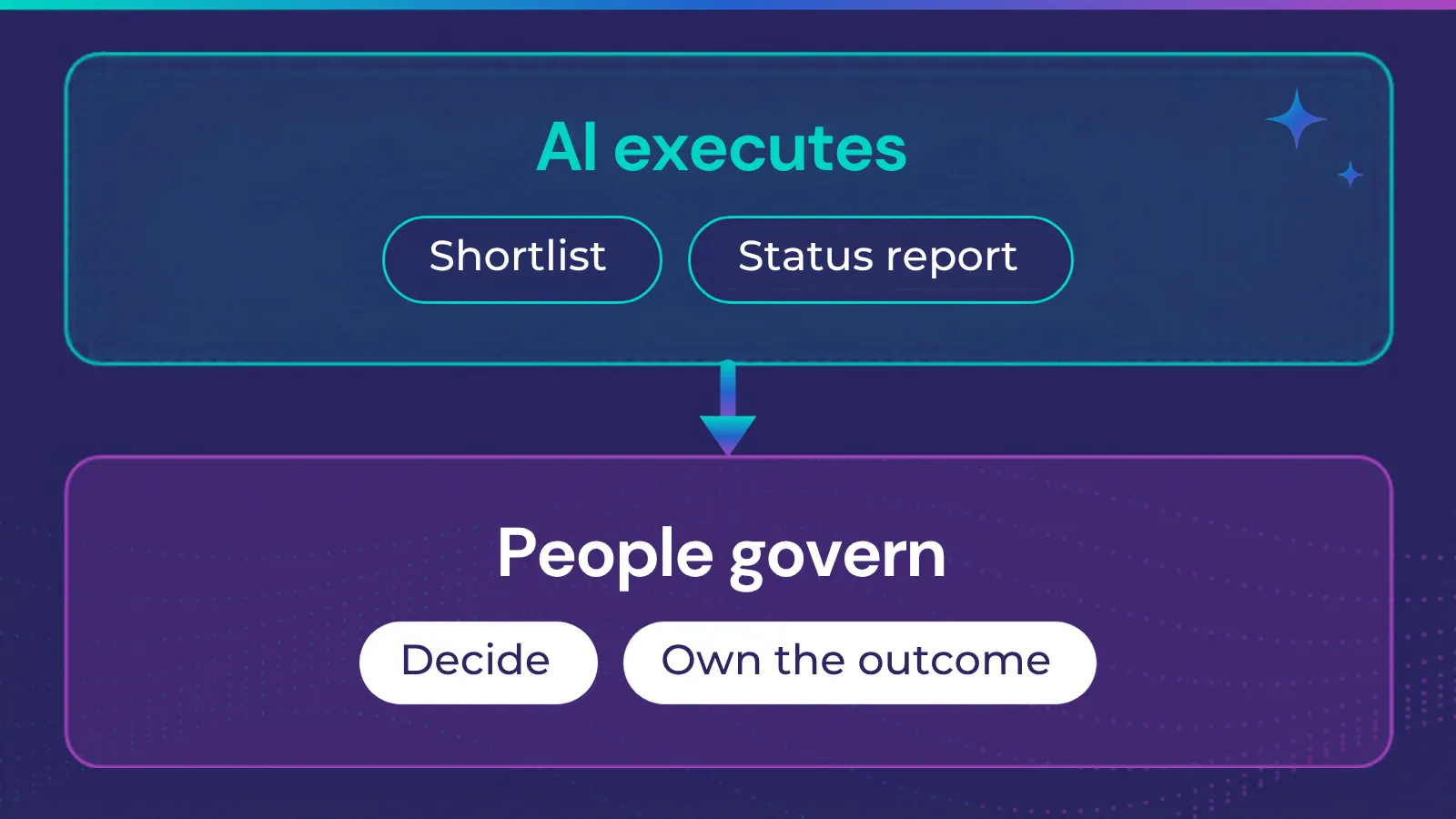
My view is simple. The CEO owns AI transformation leadership. But the CEO, the CHRO and the CIO or CTO have to design it together, with one shared plan rather than three separate ones. The technology plan and the people plan are the same plan now.
What does AI transformation leadership look like in practice?
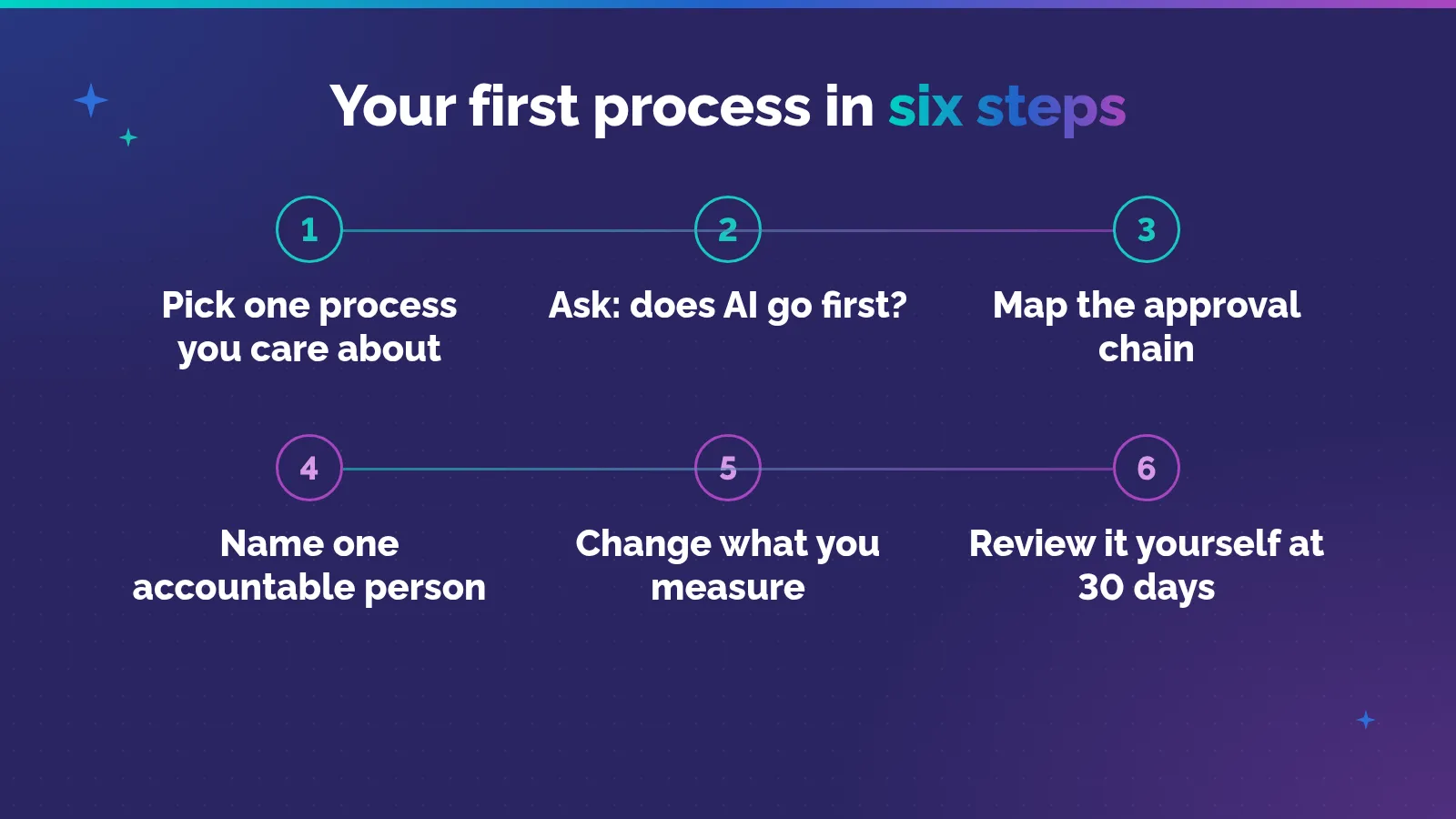
Start small, and own it yourself. Here’s the order I’d follow for the first process.
- Pick one process you personally care about. Not a side pilot that nobody senior watches. Something that matters to the business and touches more than one team.
- Ask one simple question: does AI go first? In this process, does AI produce the first output while a person checks and decides? Or is a person still doing the work with AI helping? I explain the question in What Is an AI-Native Organization?
- Map the approval chain. Write down every sign-off between the first draft and the final decision. Next to each one, write the decision it adds. Remove or merge the ones with nothing written next to them.
- Name one accountable person for the result. Back in 2022 I wrote that if more than one person is accountable, no one is. That rule matters even more when an agent does the work.
- Change what you measure for that team. Do it before you change the tool. If the measures still reward volume or headcount, the new process won’t survive its first busy month.
- Review it yourself after 30 days. Not through a status report. Sit with the team, look at what changed, and decide what the second process is.
At Solvait, we put the “does AI go first?” question to our own processes one at a time, as I described in The Redesign Imperative.
None of this needs a big program. It needs a leader who’s willing to change their own calendar first.
If you’re leading one of these changes and something other than the tech is stuck, drop me a message. I’d like to hear what it is.
Frequently asked questions
What is AI transformation leadership?
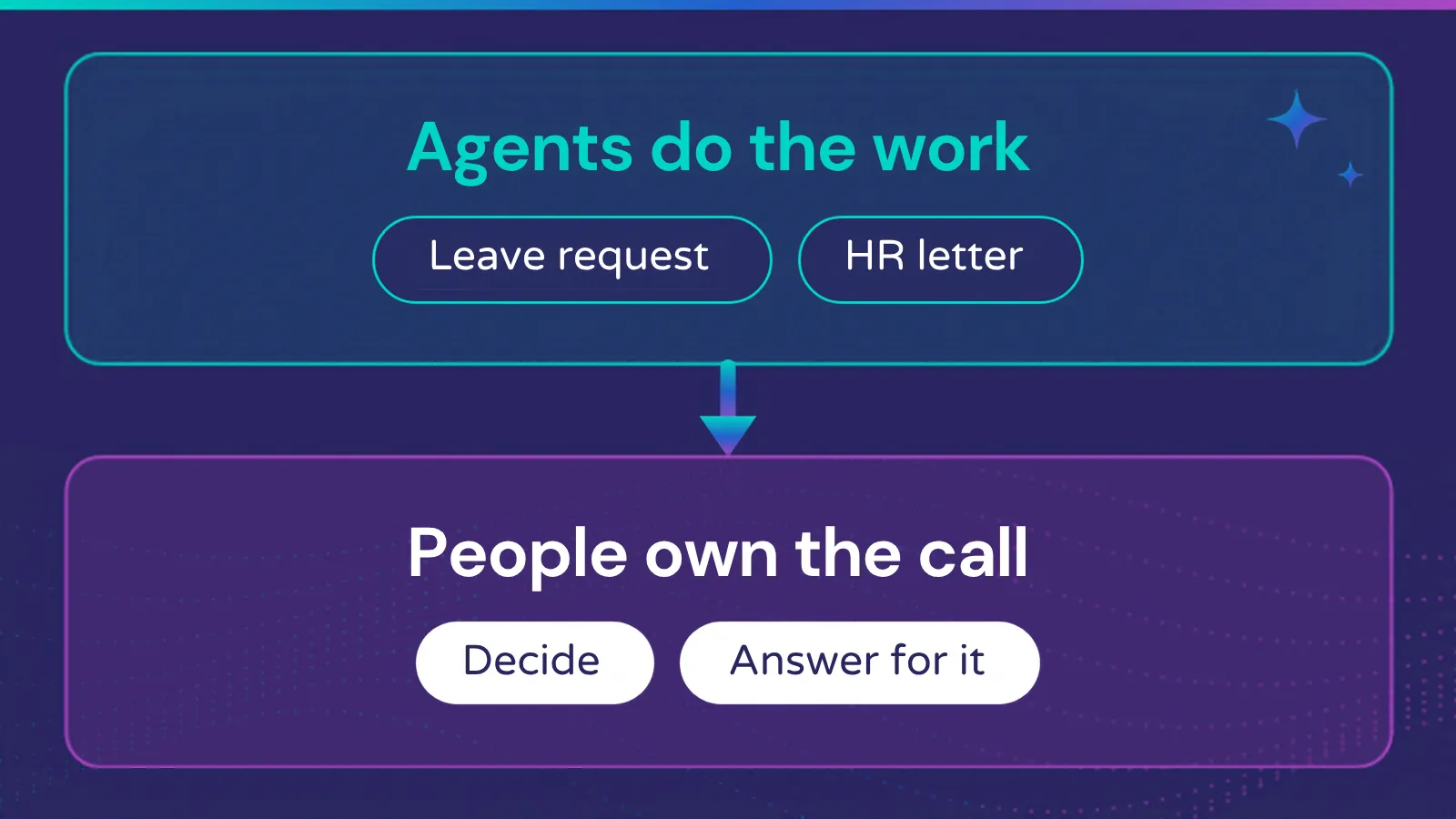
AI transformation leadership is the work a CEO and senior team do to redesign the organization around AI: approval chains, roles, incentives and their own habits. Buying tools and running pilots can be delegated. Changing what the organization rewards and who decides what can’t, which is why the CEO has to own it personally.
Why do AI programs stall when the technology works?
Because most of the problems sit elsewhere. BCG’s 2024 research found that around 70% of AI implementation challenges come from people and process issues, about 20% from technology and only 10% from the algorithms. Companies that put most of their effort into the technical side are working on the smallest part of the problem.
Who should lead an AI transformation, the CEO or IT?
The CEO. IT can choose and run the tools, and HR can run training. Only the CEO can remove an approval layer, redraw roles across departments or change how managers are measured. In practice the CEO leads, and the CHRO and CIO or CTO design the plan with them as one shared plan.
What’s the first thing a leader should change?
What they measure. If managers still gain standing from team size or visible effort, every tool you add will be quietly pushed back. Pick one team, change one measure, then redesign the process. The resistance you meet in that first month tells you where the real work is.
Does this mean removing all approvals?
No. Keep checks where a mistake is costly, such as pay, contracts and compliance, and make sure each one has a clear owner. Remove the ones that exist only because they always have. A simple test: if nobody would notice the sign-off disappearing, it isn’t adding a decision.
References
- Boston Consulting Group, “AI Adoption in 2024: 74% of Companies Struggle to Achieve and Scale Value” (press release on the report Where’s the Value in AI?), October 24, 2024. https://www.bcg.com/press/24october2024-ai-adoption-in-2024-74-of-companies-struggle-to-achieve-and-scale-value (74% without tangible value; 26% beyond proofs of concept; about 70% people and process, 20% technology, 10% algorithms)
- McKinsey & Company (Hannah Mayer, Lareina Yee, Michael Chui, Roger Roberts), “Superagency in the workplace: Empowering people to unlock AI’s full potential,” January 28, 2025. https://www.mckinsey.com/capabilities/mckinsey-digital/our-insights/superagency-in-the-workplace-empowering-people-to-unlock-ais-full-potential-at-work (leadership as the biggest barrier; C-suite more than twice as likely to cite employee readiness as their own role; 47% too slow, of whom 46% cite skill gaps and 8% complex approval processes)
- World Economic Forum, “Future of Jobs Report 2025: 78 Million New Job Opportunities by 2030 but Urgent Upskilling Needed to Prepare Workforces,” January 7, 2025. https://www.weforum.org/press/2025/01/future-of-jobs-report-2025-78-million-new-job-opportunities-by-2030-but-urgent-upskilling-needed-to-prepare-workforces/ (63% of employers cite skills gaps as a main barrier to transformation)
- IBM Institute for Business Value, “New IBM CHRO Study: AI Puts Critical Thinking at the Center of Workforce Priorities,” September 21, 2026. https://newsroom.ibm.com/2026-09-21-new-ibm-chro-study-ai-puts-critical-thinking-at-the-center-of-workforce-priorities (46% don’t involve the CHRO in AI strategy; 73% of CHROs struggle to coordinate across the C-suite; only 28% of CHROs report a joint roadmap with IT backed by a shared operating cadence)