Last updated: October 26, 2026
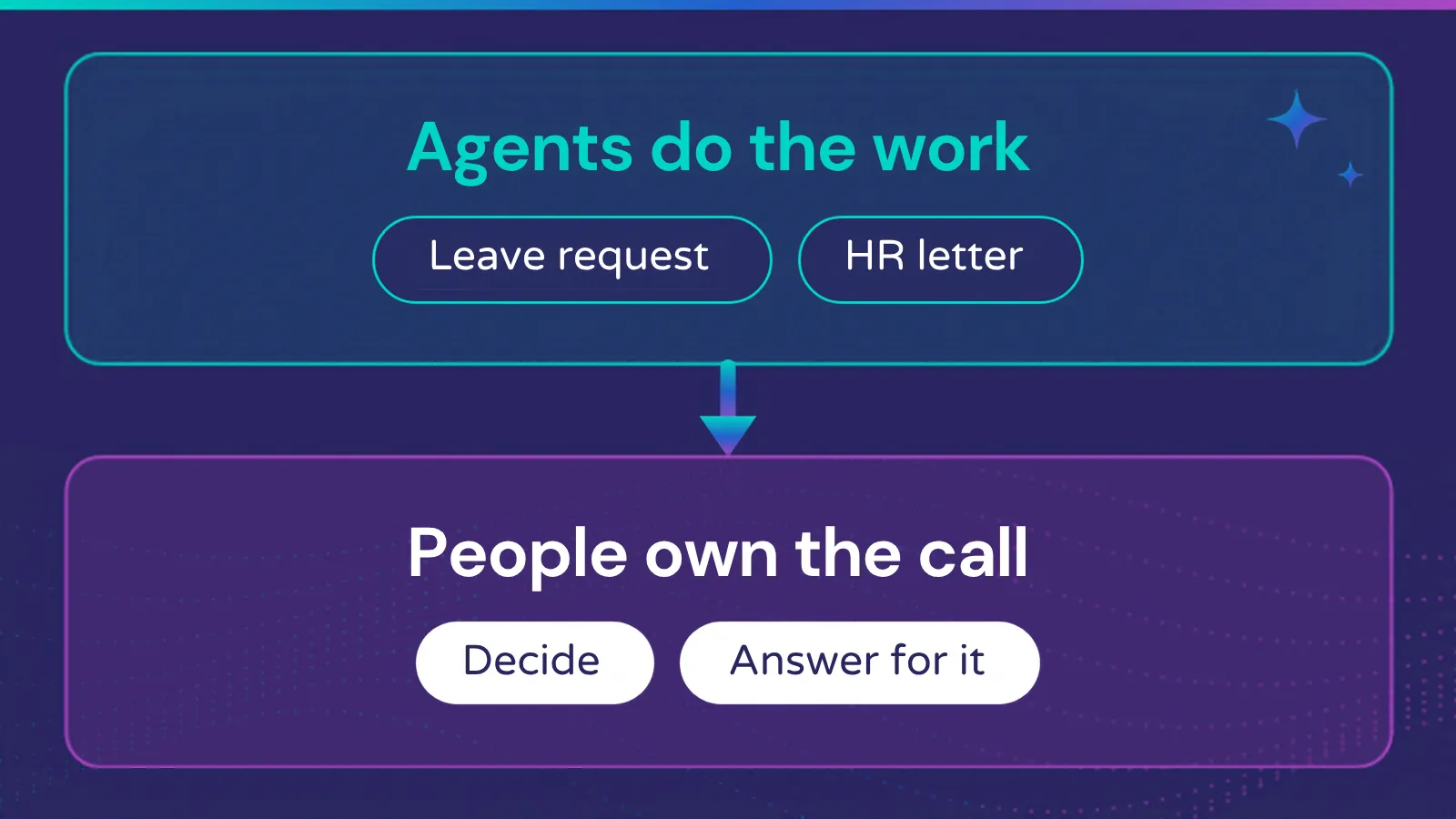
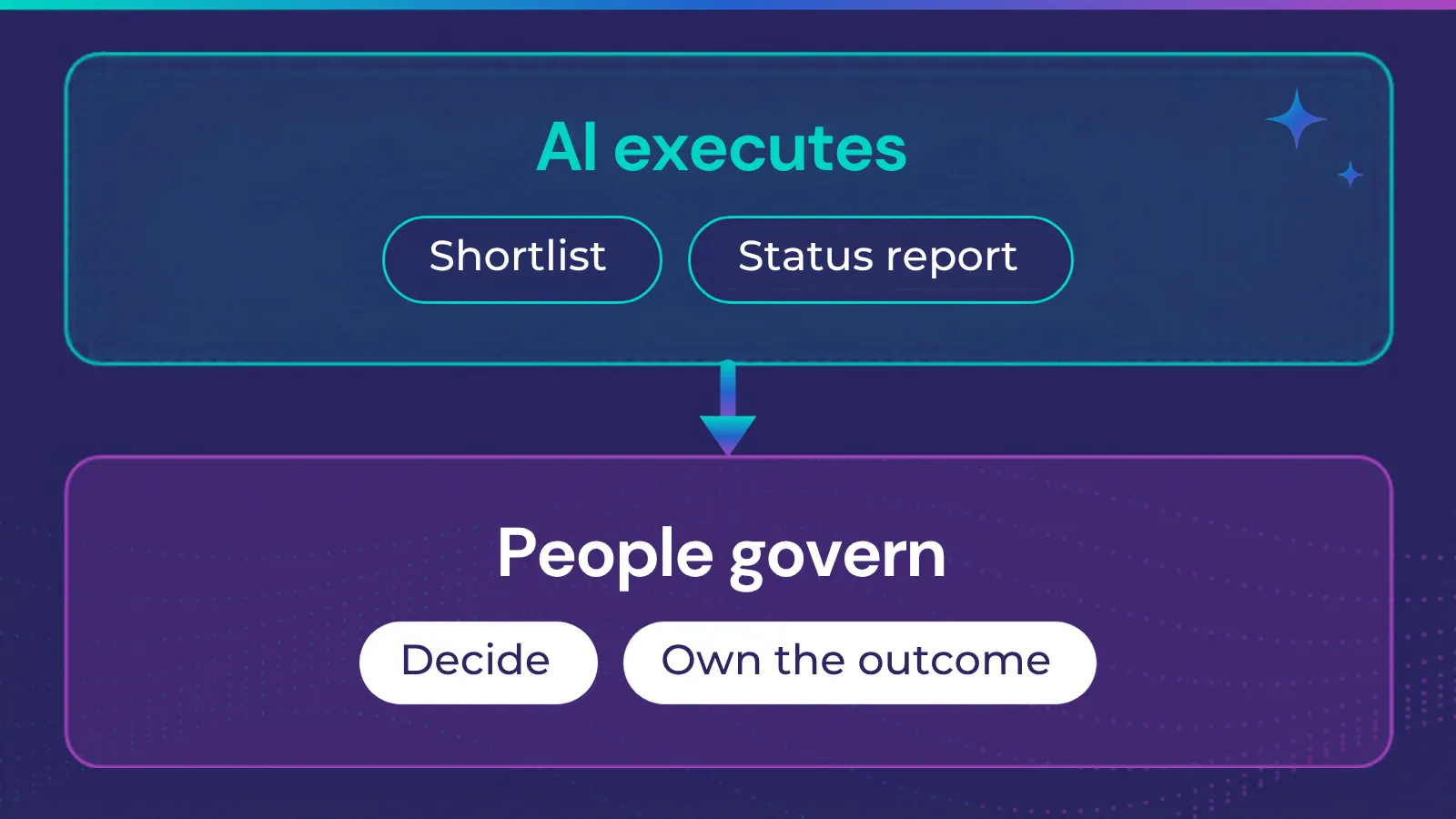
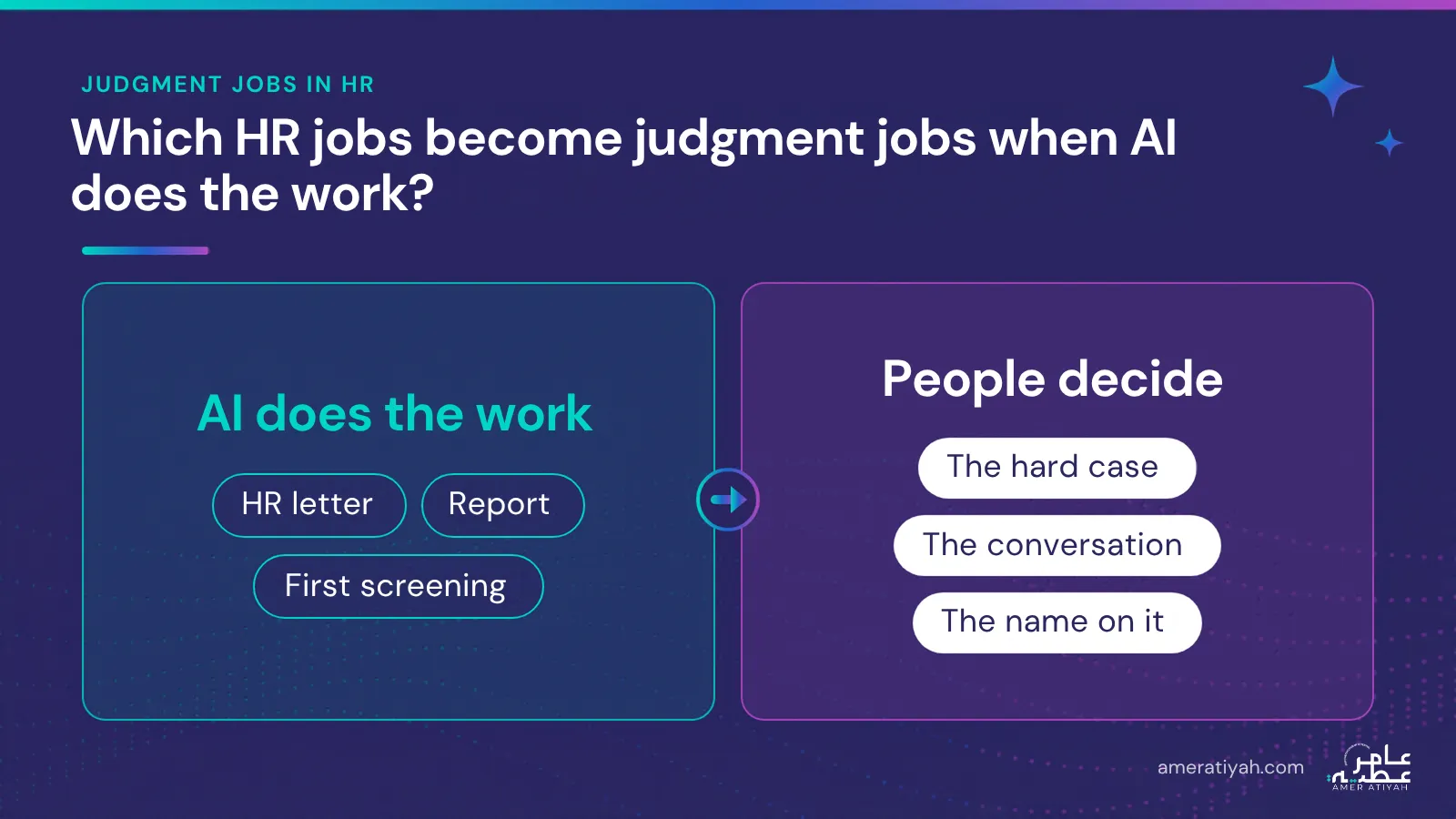
A judgment job is a role where the main work is deciding, not producing. As AI takes over HR’s routine output (letters, reports, first screenings, first drafts), most HR roles keep their titles but change their day: less producing, more checking, deciding and answering for the result. AI executes, people govern.
A question I hear often from HR people is “Will AI take my job?” I think it’s the wrong question. The better one is: “Which part of my job is production, and which part is judgment?” The production part is moving to AI, whether we like it or not. The judgment part is becoming the whole job.
I run Solvait, an agentic AI HR company, so I think about this every day, for our clients and for my own team. This post is for HR leaders, and for HR people, in Saudi Arabia and the Gulf who want a plain answer: which HR roles change, how they change, and what to do about it this month.
What is a judgment job in HR?
Every HR job has always been a mix of two kinds of work.
Production work makes something: the salary certificate, the monthly headcount report, the first screening of 300 CVs, the draft job description, the answer to “how many days of leave do I have?”. It follows a known pattern. It takes time. And until recently, only a person could do it.
Judgment work decides something: which of the three final candidates to hire, whether this payroll exception is fair, what to say to a manager whose best person just resigned, how to handle a complaint where both sides have a point. There’s no clean answer, and someone has to stand behind the call.
For most of HR’s history, production work filled the day and judgment work was squeezed in between. AI flips that. When the production happens in minutes, what’s left of the job is mostly judgment. That’s what I mean by a judgment job: the same role, with the production taken out and the judgment made the main work.
So the question for every HR role isn’t whether AI touches it. It’s how much of the day is production, and how fast that part is moving.
How do you tell production work from judgment work?
I use three simple tests. They’re my own way of drawing the line, not an industry standard.
- Is there a clean answer? If the policy and the data settle it, it’s production. If two good HR people could look at the same facts and disagree, it’s judgment.
- Does someone have to trust a person? An employee in a hard situation, a candidate deciding whether to join, a manager who needs honest advice. If the work only works because someone trusts the person doing it, it’s judgment.
- Does a name have to be on it? Some outcomes need a person who answers for them: a hiring decision, a termination, a pay change. If someone has to own the result, the decision is judgment, even when AI prepared everything before it.
If the answer to all three is no, AI goes first. If even one answer is yes, a person stays in charge of the decision, and AI does the preparation.
Which HR roles change, and how?
Here is how I see the main HR roles splitting. The titles mostly stay. What changes is where the day goes.
| HR role | What AI can do first | What stays with people | The judgment job it becomes |
|---|---|---|---|
| Recruitment specialist | Sourcing, first CV screening, scheduling, outreach messages, interview notes | Who gets the offer, reading people in the interview, showing a candidate what the company is really like | Hiring judge and candidate advisor |
| HR operations / employee services | HR letters, leave requests, profile updates, routine policy questions | The unusual request, the employee who is upset, the case the policy didn’t foresee | Exceptions owner |
| Payroll specialist | Monthly calculations, checks, flagging unusual changes | Approving exceptions, fixing a mistake in someone’s pay, explaining it to them | Payroll owner who answers for every unusual number |
| Performance and talent | Pulling the data, first drafts of reviews, preparing calibration packs | Fair ratings, promotion calls, the review conversation itself | Fairness and growth judge |
| Learning and development | Course suggestions, first drafts of development plans, tracking completion | Which skills the business really needs, coaching, deciding who gets which chance | Capability planner and coach |
| Workforce planning and HR analytics | Headcount reports, staffing mix, cost scenarios | Which scenario to choose, what to tell leadership, the trade-offs | Advisor to leadership on workforce choices |
| Employee relations | Case summaries, timelines, finding the relevant policy | Investigations, disciplinary decisions, terminations | Stays a people-only job, with better facts |
| HR business partner / CHRO | Preparing data, options and drafts for decisions | Organization design, which work goes to AI, who owns each AI workflow | Designer of how people and AI work together |
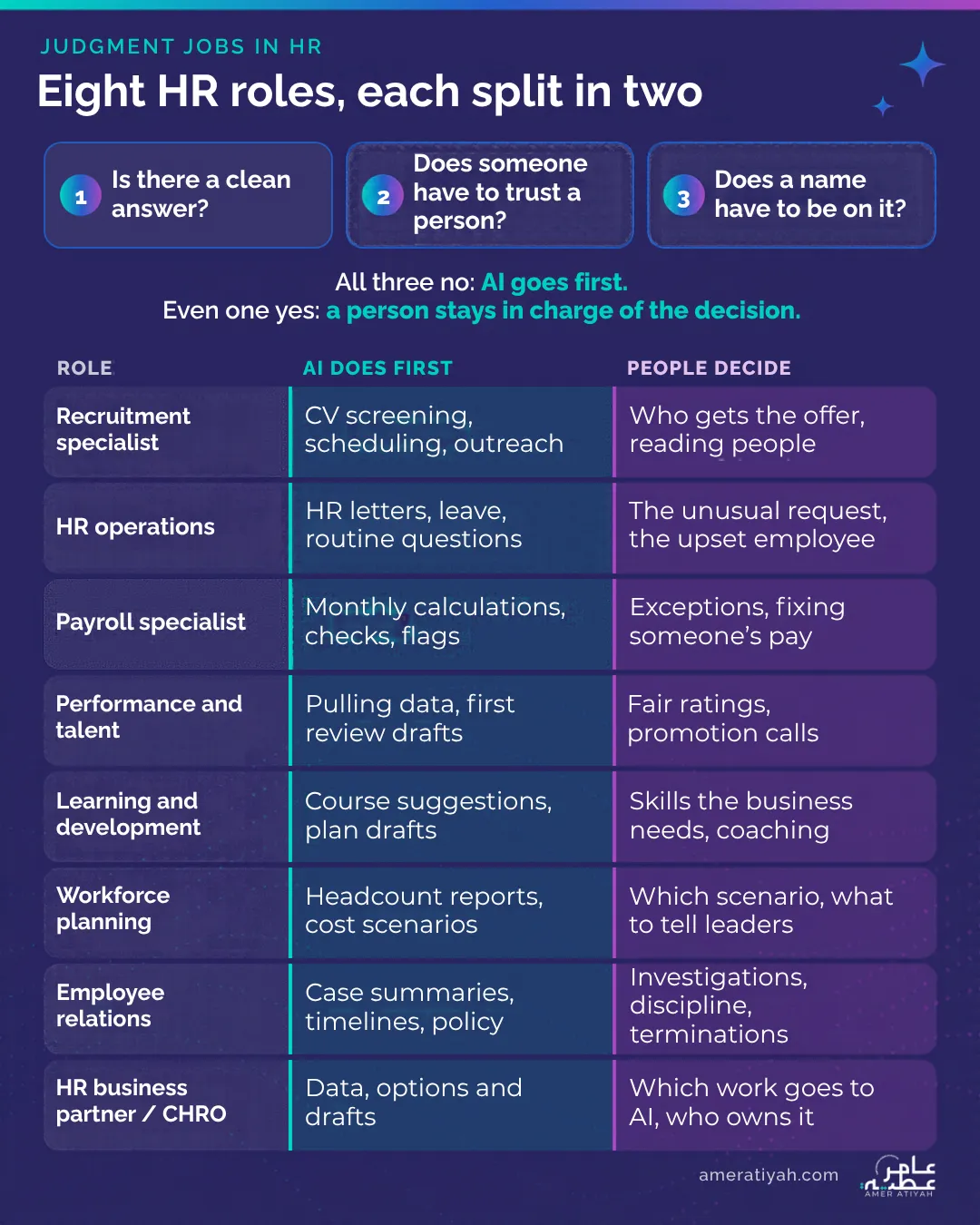
Two things stand out when you read the table down, not across.
First, no role disappears completely. Every row still has real work in the people column. But in some rows (HR operations, payroll, recruitment) most of today’s hours sit in the AI column. Those are the roles that change the most, and the people in them need the most support.
Second, the people column is harder work than the AI column. Telling a candidate no, with respect. Deciding a payroll exception that affects someone’s family. Telling the CEO which workforce plan you’d pick and why. These were always the most valuable parts of HR. They just used to be crowded out by production.
Which HR work should stay with people?
Some HR work should stay with people even when AI could technically do it. I’d draw the line around four things:
- Decisions that change someone’s life. Hiring, firing, discipline, promotion, a pay change. AI can prepare the facts. A person decides and says it to the employee.
- Conversations that need trust. The employee going through something hard, the manager who’s struggling, the candidate who’s unsure. People talk to people.
- Fairness calls. Is this rating fair? Is this exception fair to everyone else? Fairness needs someone who can be questioned and can explain.
- Ownership. Every AI workflow in HR needs one named person who answers for it. That job can never go to AI.
I made the same split, in more detail, in agentic AI in HR: what to give the agents and what to keep. This post looks at the same line from the other side: not the work, but the jobs.
Why does this matter for HR teams in Saudi Arabia and the Gulf now?
Because the production side of HR is moving to AI now, while most HR job descriptions still describe the old day. Three things are new.
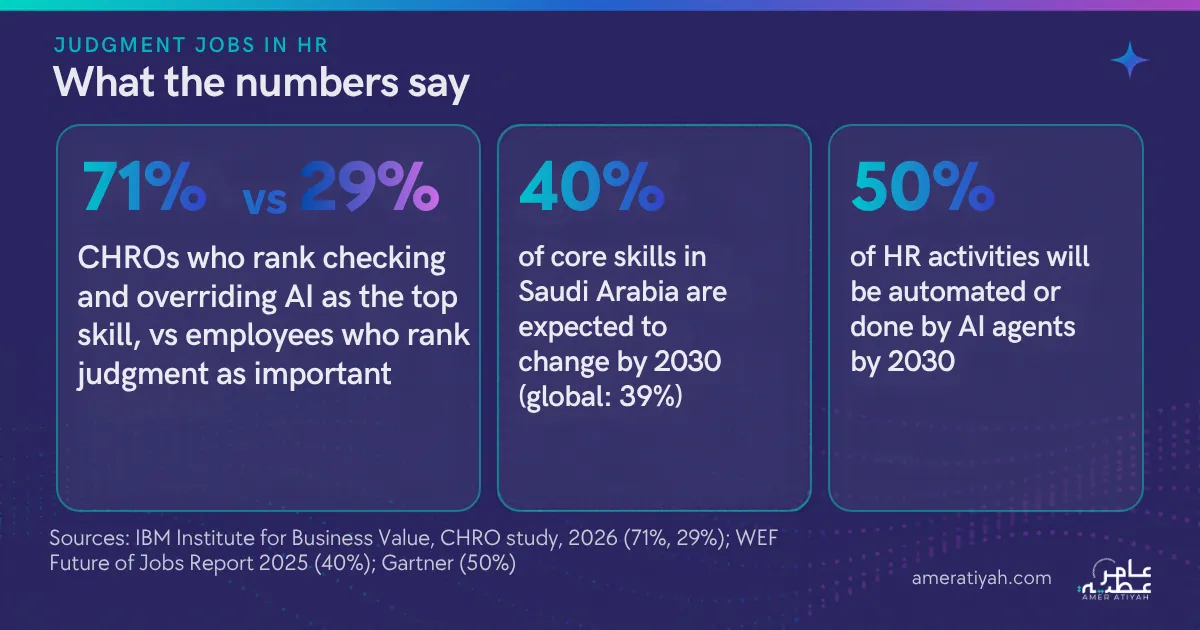
AI is starting to do HR work, not just help with it. Gartner forecasts that by 2030, 50% of HR activities will be automated or done by AI agents (Gartner). Across all kinds of work, employers in the World Economic Forum’s survey estimate that today 47% of tasks are done mainly by people, 22% mainly by technology and 30% by both. By 2030 they expect the three to be nearly even, about a third each (World Economic Forum, Future of Jobs Report 2025).
This region is moving faster than most. Companies in Saudi Arabia expect 45% of work tasks to be done mainly by technology by 2030, well above the global figure of about a third. They also expect 40% of workers’ core skills to change between 2025 and 2030, slightly above the global average of 39%. And the same report notes that employers in Saudi Arabia and the UAE are planning to speed up automation (World Economic Forum, Future of Jobs Report 2025).
Leaders and employees aren’t reading the change the same way. IBM’s 2026 CHRO study found that 71% of CHROs see the ability to supervise, check and override AI output as the most essential workforce skill, but only 29% of employees rank judgment as important (IBM Institute for Business Value, September 21, 2026).
Put those together. The production work in your HR team will move to AI over the next few years, whether or not anyone rewrites the jobs. If you train your HR people only on the tools, they’ll get faster at the part that’s leaving. Train them to check, decide and explain, and they’ll be ready for the part that’s growing. I wrote about this pressure on HR earlier in how AI is rewriting the HR role in Saudi Arabia.
What skills does a judgment job need?
Not the ones most job descriptions list today.
That 71% vs 29% gap is the whole problem in two numbers. Leaders know the job is turning into judgment. Many employees haven’t been told, or haven’t been trained for it. In the same IBM study, CHROs named critical thinking (57%) and human judgment (48%) among the most important abilities, while 60% of employees worry AI is wearing their skills down, with critical thinking named most often (IBM Institute for Business Value).
The World Economic Forum points the same way: analytical thinking is the top core skill for seven in ten employers, and talent management is among the top ten skills rising in importance (World Economic Forum).
In plain terms, an HR judgment job needs people who can:
- Check AI’s work and spot when it’s wrong, not just accept it because it looks neat.
- Ask the right question before asking AI for an answer.
- Weigh people and fairness, not only policy.
- Explain a decision to the person it affects, face to face.
- Own the result, and say “that was my call” when it goes wrong.
There’s a warning in the IBM study too. 80% of CHROs say AI creates “invisible” work: checking recommendations, fixing mistakes, adding context, handling exceptions. That invisible work is the judgment job. If you don’t write it into the role, people do it on top of their old job and nobody sees it.
How do you redesign one HR role, starting this month?
Pick one role, not the whole department. Then:
- List one real week. Ask two or three people in the role to write down what they actually did last week, task by task. Not the job description. The real week.
- Sort every task with the three tests. Clean answer? Trust? Name on it? Anything that fails all three is a candidate for AI to do first.
- Move the production work to AI, one task at a time. Start with the highest-volume task. Measure time and errors before and after.
- Rewrite the job description around the judgment work. What does this person decide? What do they check? What do they own? If the new description still reads like a list of outputs, it isn’t finished.
- Train for judgment, not just for the tool. Teach people how to check AI’s work, when to override it, and how to explain a decision.
- Name the owner of every AI workflow that touches the role, and make that ownership part of someone’s job, not a favor.
If you want a faster first pass across your whole organization, try the Scarcity Audit. It’s free, takes about five minutes and asks 12 questions. It shows you where people are still doing work that AI could do first, which is exactly where your next judgment jobs are hiding.
This idea is at the heart of the book I’m writing on the AI-native organization.
If you want one idea and one honest note from building this every month, subscribe to The AI HR Newsletter.
Frequently asked questions
Will AI replace HR jobs?
Not most of them. AI will replace many HR tasks, not most HR jobs. The routine production work (letters, leave requests, reports, first CV screenings) moves to AI. What stays is judgment: hiring and pay decisions, hard conversations, fairness calls and owning the result. Most HR roles keep their titles, but their day changes.
The roles that change most are the ones whose day is mostly production. Whether that means fewer people or a stronger HR team is a leadership choice. For the task-by-task view of what to hand to AI agents and what to keep, see agentic AI in HR.
Which HR roles are most affected by AI?
The roles with the most repeated, pattern-based work: HR operations and employee services, payroll processing, and the screening side of recruitment. Their titles will likely stay, but most of their current hours can move to AI. The people in them move toward exceptions, checks and decisions.
Which HR work should never be handed to AI?
Decisions that change someone’s life (hiring, termination, discipline, pay changes), conversations that depend on trust, fairness calls, and ownership of every AI workflow. AI can prepare the facts for all of these. A named person should make the decision and explain it.
What skills do HR professionals need in the AI era?
The ability to check AI’s work and override it when it’s wrong, critical thinking, fairness and people judgment, clear explanation of decisions, and willingness to own the result. IBM found 71% of CHROs rank supervising, checking and overriding AI as the most essential skill, while only 29% of employees rank judgment as important. Closing that gap is HR’s job.
Why is this urgent for HR teams in Saudi Arabia and the Gulf?
Because the change is already under way here. In the World Economic Forum’s survey, companies in Saudi Arabia expect 45% of work tasks to be done mainly by technology by 2030 and 40% of workers’ core skills to change, and employers in Saudi Arabia and the UAE plan to speed up automation. Gartner expects half of HR activities to be automated or done by AI agents by 2030. HR teams that redesign their roles around judgment now will set the pace instead of catching up.
What is a judgment job?
A judgment job is a role where the main work is deciding, not producing. AI does the first version of the routine output, and the person checks it, decides the hard cases, talks to the people affected and answers for the result. In short: AI executes, people govern.
References
- World Economic Forum, The Future of Jobs Report 2025, Chapter 2: Jobs outlook, January 2025 (47% / 22% / 30% of work tasks today; nearly even split by 2030, Figure 2.7)
- World Economic Forum, The Future of Jobs Report 2025, Chapter 3: Skills outlook, January 2025, and the full report (PDF) (39% of core skills change by 2030; Saudi Arabia 40%, Figure 3.2; analytical thinking essential for seven in ten employers, Figure 3.3; talent management among the top ten skills on the rise, Figure 3.4; Saudi Arabia and UAE employers accelerating automation and Saudi Arabia 45% of tasks mainly by technology by 2030, regional profiles, Middle East and Northern Africa)
- Gartner, Agentic AI in HR: Strategic Foundations for CHROs, undated topic page, read October 25, 2026 (50% of HR activities automated or agent-driven by 2030)
- IBM Institute for Business Value, New IBM CHRO Study: AI Puts Critical Thinking at the Center of Workforce Priorities, September 21, 2026 (71% vs 29%; 57% and 48%; 60%; 80% invisible work)