

Last updated: November 26, 2026
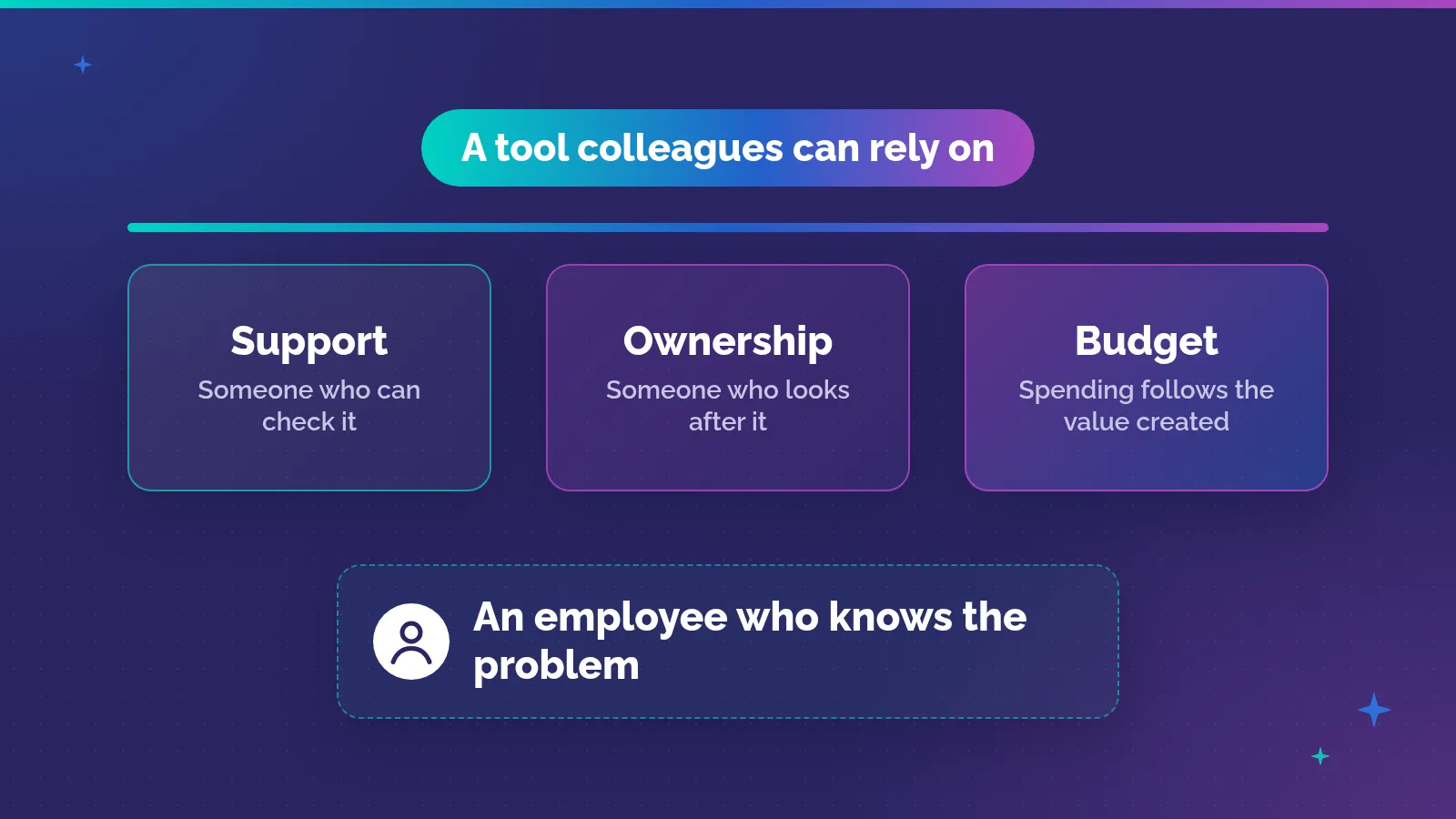
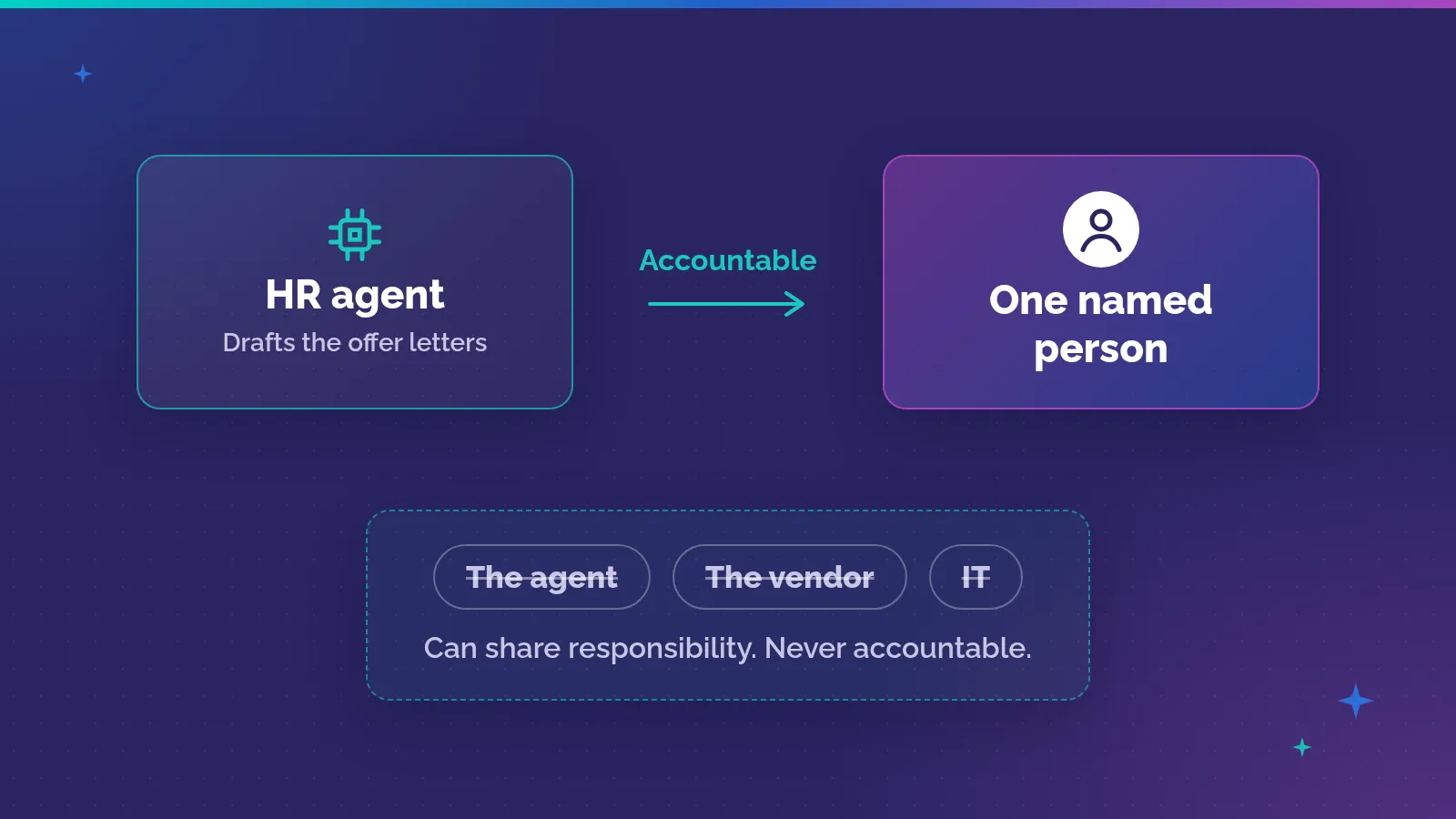
AI accountability in HR means one named person answers for every result an AI agent produces, even when no person touched the work. The agent can’t be that person. Neither can the vendor or IT. If you don’t name someone before the agent starts, the blame will land on whoever clicked last, and that’s usually the wrong person.
In my own work I’ve seen a lot of biased decisions that AI has made in interviews. Not one company I can name. A pattern. The tool ranks or screens someone, the outcome looks unfair, and nobody is sure who owns it: the recruiter, the vendor, IT, or “the system.”
Back in 2022 I wrote a short post on accountability, responsibility and authority. Its main line was simple: if more than one person is accountable, no one is. I wrote it about people. Four years later, I think it matters even more for agents. Especially in hiring, where a biased screen can close a door before a person ever meets you.
What happens when hiring AI gets a person wrong?
The research says the pattern is real. The ownership question is usually the part nobody answered in advance.
In 2024, Kyra Wilson and Aylin Caliskan at the University of Washington tested how three AI language models rank resumes. They used more than 500 public resumes and 500 job descriptions, across more than three million comparisons. Resumes with White-associated names were preferred in 85.1% of the bias tests, and those with Black-associated names in 8.6%. When the researchers compared White male names with Black male names, the White male names were preferred in all 27 tests.
One honest note. In August 2026 the authors corrected the paper: a coding error had flipped the results of the gender-only comparisons. The race and intersectional results weren’t affected, and a team at Salzburg University replicated them. So I use only those results here, and none of the gender figures that circulated in 2024.
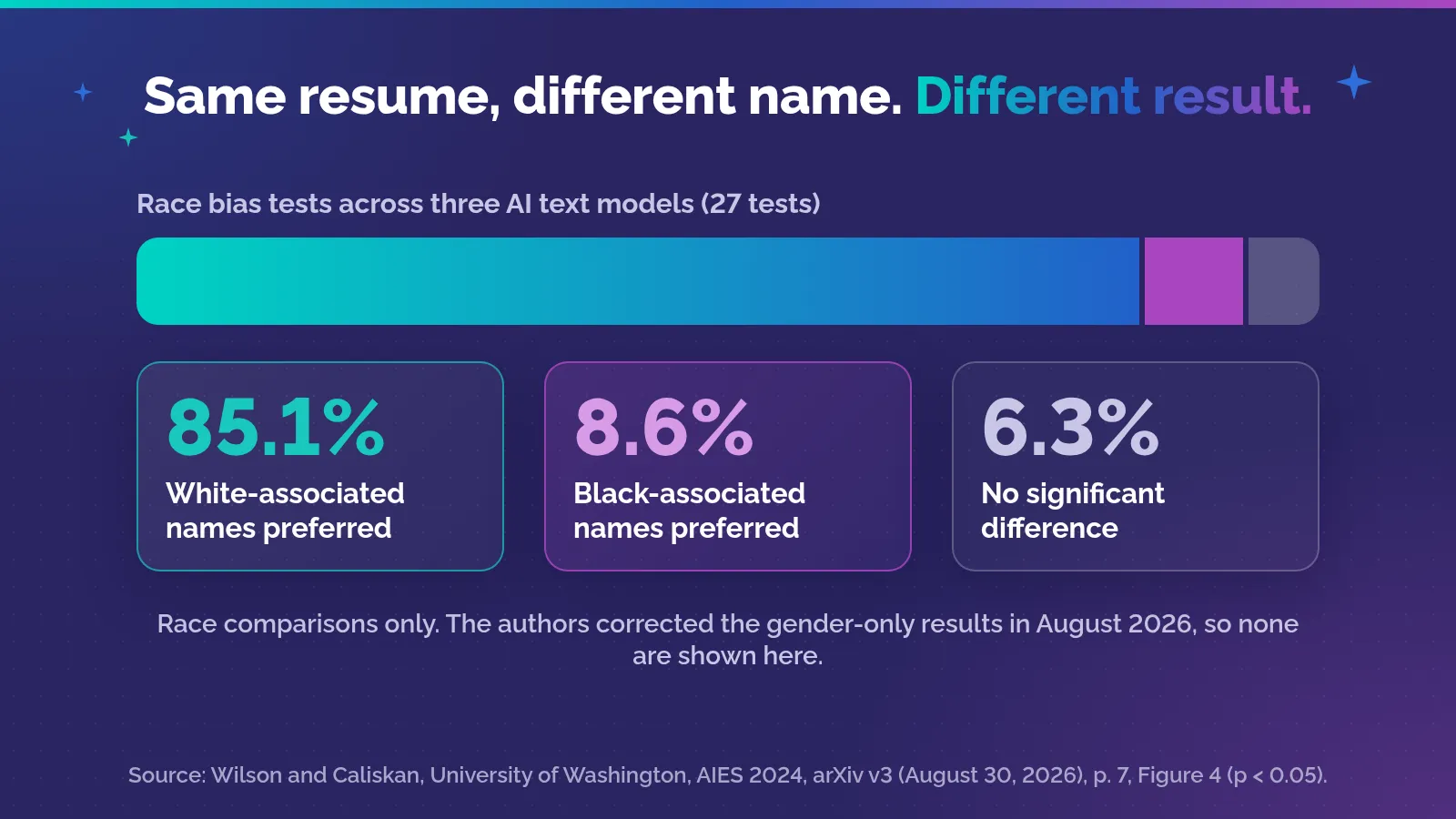
Race bias tests only, from Wilson and Caliskan (University of Washington, AIES 2024), arXiv version 3, p. 7, Figure 4. The authors corrected the gender-only results in August 2026, so none are shown.
Here is how a few known cases ended up when someone finally asked who answered for the result.
| Case | What happened | Where it ended up | Source |
|---|---|---|---|
| Amazon’s experimental recruiting tool, reported in 2018 | According to Reuters, as reported by the BBC, a tool that scored candidates from one to five stars learned from ten years of CVs that came mostly from men, and penalized CVs that included the word “women” | The project was abandoned. Reuters was told recruiters looked at its recommendations for a period but never relied on it alone. Amazon didn’t respond to the claims | BBC News, October 10, 2018 |
| iTutorGroup, settled in 2023 | According to the EEOC’s lawsuit, the company’s application software was programmed to reject female applicants aged 55 or older and male applicants aged 60 or older, and more than 200 qualified U.S. applicants were rejected | The company agreed to pay $365,000, with training, a new anti-discrimination policy and at least five years of EEOC monitoring | U.S. EEOC, September 2023 |
| Mobley v. Workday, filed in 2023 | Derek Mobley alleges that Workday’s AI applicant recommendation system discriminated on race, age and disability. Four other applicants over 40 say they applied for hundreds of jobs through Workday and were rejected almost every time without an interview | In May 2025 a federal court in California gave preliminary approval for the age claim to proceed as a collective action. The case was still in pretrial stages in November 2026, with no finding that the tool discriminated | U.S. District Court, N.D. California, order of May 16, 2025, and docket |
The Mobley order has one line I keep coming back to. The court summarized the claim as employers that “delegate traditional hiring functions, including rejecting applicants, to the algorithmic decision-making tools provided by Workday.” Delegating the work is exactly what an agent is for. The question is who still answers for it.
What do the rules already say about who answers?
More than most HR teams expect. Saudi Arabia, New York City and the European Union each come at it differently, but they land in a similar place: a person, inside the company using the tool, has to own the result.
| Rule | Who it covers | What it says about who answers |
|---|---|---|
| SDAIA AI Ethics Principles, May 2025 | All AI stakeholders in the Kingdom, including public and private entities (p. 9) | Responsibility for an AI system’s outcomes should be attributable to the stakeholders responsible for each action, with authorization and responsibility areas defined “without leaving any areas of uncertainty” (p. 26). Decisions that are irreversible or difficult to reverse should trigger human oversight and final determination (p. 23) |
| New York City Local Law 144, enforced since July 5, 2023 | Employers and employment agencies using an automated employment decision tool in the city | A bias audit within the past year and notices to candidates are required. The employer is responsible for making sure the audit was done, and the vendor that created the tool is not (DCWP FAQ, sections I.1, II.4 and V.1) |
| EU AI Act, Regulation (EU) 2024/1689 | Providers and deployers of AI systems in the EU | AI for recruitment and selection, and for decisions on promotion, termination, task allocation and monitoring, is high-risk (Annex III, point 4, p. 127). Deployers must assign human oversight to people with “the necessary competence, training and authority” (Article 26(2), p. 68), and employers must inform workers’ representatives and affected workers before use (Article 26(7), p. 68) |
Only the first applies to every company in the Kingdom. The other two matter if you hire in New York or in the EU, or if your vendor builds for those markets. I include them because all three name the same thing: a person, with authority, before the system runs.
What does AI accountability in HR actually mean?
It means you can point to one person for every task an agent does, and that person knows it.
The 2022 post used Verne Harnish’s three words. They still work. But each one shifts a little once an agent does the first version of the work.
| What it meant in 2022 | What changes when an AI agent does the work | HR example: an agent drafting offer letters | |
|---|---|---|---|
| Accountability | The ONE person who tracks the work and raises the alarm when it goes wrong | Still one person. Never the agent, never the vendor, never “the system” | The talent acquisition lead |
| Responsibility | Anyone who touches the process and can help | Now includes the people who set the agent up, keep its data right and check its output | The recruiter who reviews each letter, the HR systems team that keeps the salary bands current |
| Authority | Whoever holds the final decision | Has to be written into the agent’s limits: what it may do alone, and what it must hand to a person | The hiring manager approves the salary. The agent can’t change pay on its own |
Look at the last column. Nothing in it is new. The only new thing is that the work now moves faster than anyone’s habit of asking “whose is this?”
Why can’t the agent, the vendor or IT be accountable?
Because accountability needs someone who can be asked to explain, and who can fix it.
An agent can’t be asked. It has no job to lose and no manager to answer to. The vendor answers for what it built, under its contract, and not for how you chose to use it in your HR process. IT answers for whether the agent runs. It doesn’t answer for whether a candidate got the right offer.
New York’s rule says this almost word for word. The employer has to make sure the bias audit was done. The vendor that created the tool isn’t responsible for it, even though a vendor can arrange an independent audit of its own tool.
Mobley shows that a vendor can be pulled into the question too. That doesn’t take the question away from the employer. If anything, it means more people will ask who decided to use the tool, and how.
In HR, a lot of decisions are hard to reverse. A rejected candidate rarely comes back. A wrong message to an employee about their contract can’t be unsent. That is exactly the kind of decision SDAIA says needs human oversight and a final human call.
Where does the blame land when nobody is named?
On the last person who clicked. Usually someone junior.
Here’s what people already do with AI at work. The 2025 global study by KPMG and the University of Melbourne surveyed 48,340 people in 47 countries, including Saudi Arabia, and 32,352 of them were employees. Two thirds of employees (66%) said they have relied on AI output at work without critically evaluating it. Over half (56%) said they have made mistakes in their work because of AI. And 57% said they have used AI in ways that weren’t transparent, such as presenting AI content as their own or not saying they used it.
Put those three numbers together and you get a familiar story. Someone used a tool nobody owned, didn’t check the result, made a mistake, and didn’t say how it happened. When it surfaces, the company blames that person. But the company never told them who owned the tool, what to check, or when to stop.
I don’t think that’s fair, and I don’t think it works. Blame without a name just teaches people to hide the next mistake better.
How much freedom are companies already giving AI?
More than their oversight can keep up with. Deloitte’s October 2026 State of AI in the Enterprise report surveyed 3,500 senior leaders in 25 countries. Forty percent said their companies already let AI make decisions without human approval, at least to a moderate degree.
Among companies running several AI agents on the same workflow, half had either no formal oversight structure or only basic oversight. Just 9% rated those workflows at the highest level Deloitte measured. Deloitte’s own advice is to separate AI that informs a decision, AI that recommends, AI that acts within defined limits and AI that acts more on its own, and then set approval, monitoring, escalation and accountability for each level.
HR leaders report a similar gap. IBM’s 2026 CHRO study found that only 23% of workflow outcomes are actively tracked with the authority to escalate, pause or override AI decisions.
None of those is a technology problem. Every one of them starts with a name, and with that person’s right to stop the work.
Which HR decisions stay with people, and which can an agent carry?
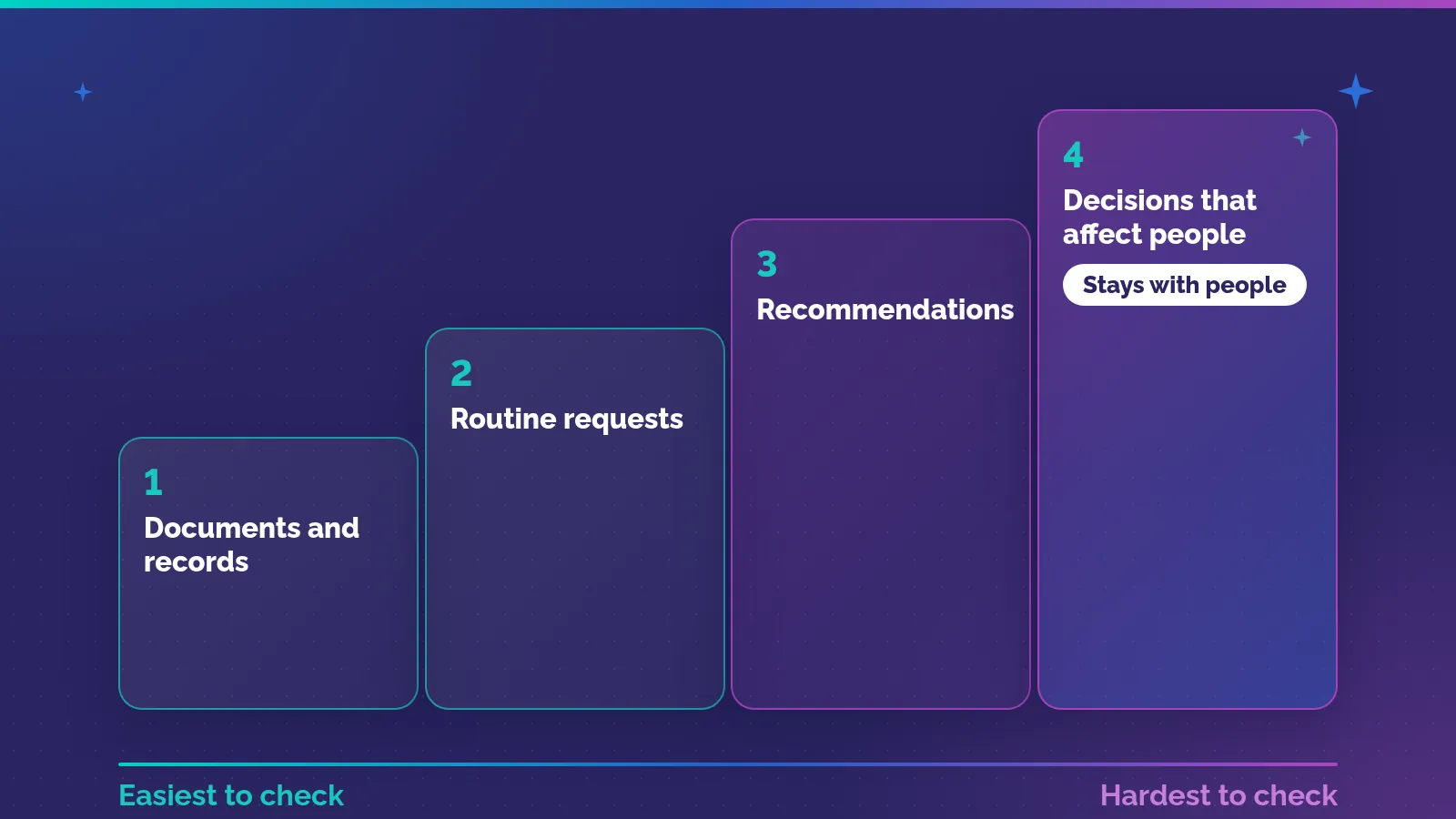
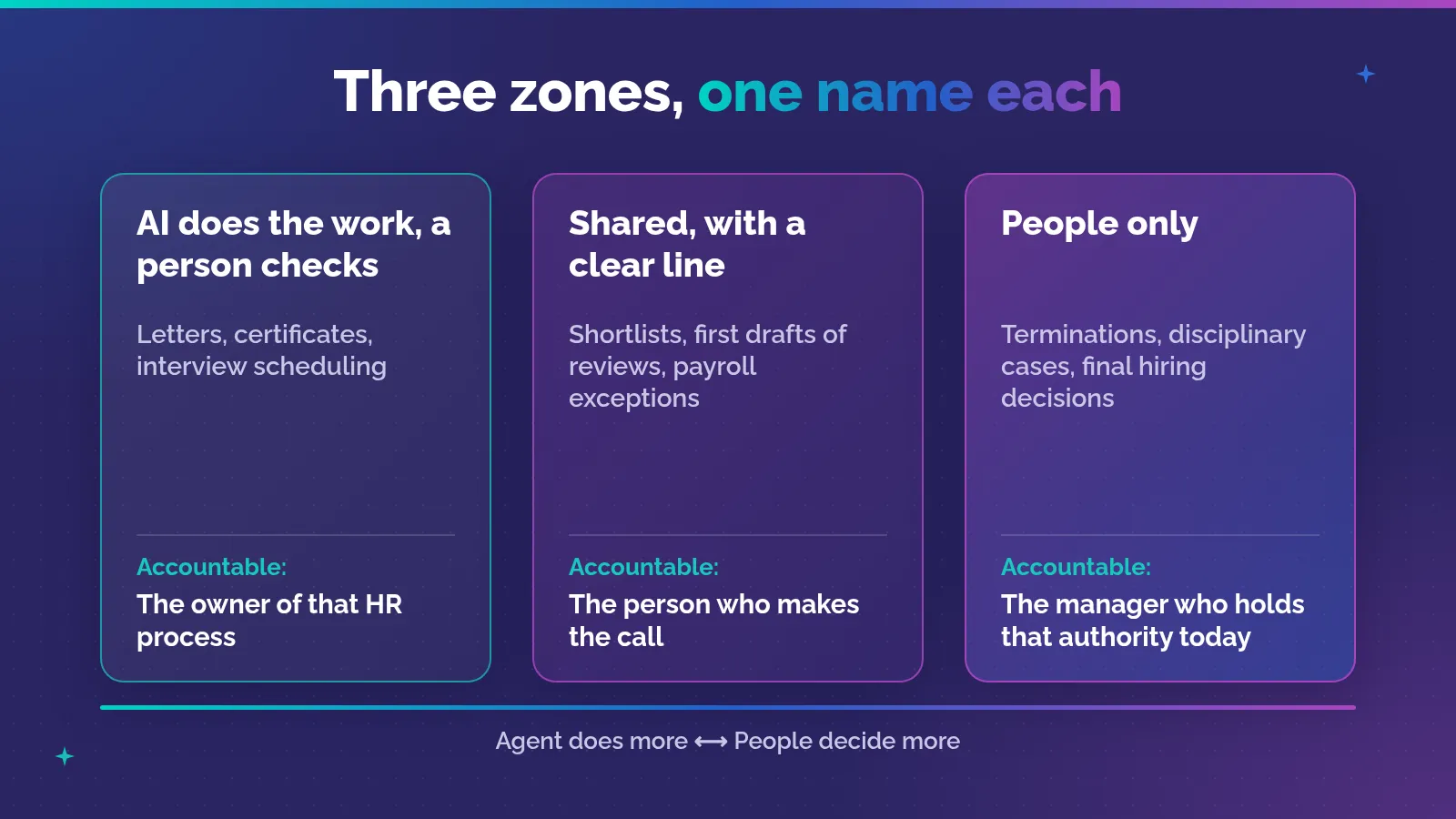
Before you name anyone, sort the work. IBM’s CHRO study found that only 26% of work is clearly defined, to a great extent, as human-led, AI-assisted or AI-executed. I find three zones enough.
In my guide to agentic AI in HR, I sorted HR work by how much the agent does. This is a different cut. Here the question is who answers for each zone.
| Zone | What it means | HR examples | Who is accountable |
|---|---|---|---|
| People only | The agent may gather facts. People decide and tell the employee | Terminations, disciplinary cases, final hiring decisions | The manager who holds that authority today. Nothing changes |
| AI does the work, a person checks | The agent completes the task. A named person checks it, or a sample of it | HR letters and certificates, interview scheduling, profile updates | The owner of that HR process, who also decides how much gets checked |
| Shared, with a clear line | The agent prepares up to a written line. A person makes the call past it | Shortlists, first drafts of performance reviews, payroll exceptions | The person who makes the call. The line itself is written down |
The middle zone, AI does the work and a person checks, needs one honest decision: how much to check. McKinsey’s State of AI report, published in March 2025, found that 27% of respondents whose organizations use gen AI say employees review all of its content before it’s used. A similar share says 20% or less gets checked. Either can be right. What isn’t right is nobody having decided.
The shared zone is where most of the trouble starts. If the line isn’t written, the agent drifts across it one small step at a time, and nobody notices until a decision that should have been human wasn’t.
Who should be accountable: the CEO, the CHRO, IT or the line manager?
Two different things get mixed up here.
The first is who owns AI across the company: the rules, the risk, the budget. That belongs at the top. McKinsey found that CEO oversight of the company’s AI rules is one of the elements most linked to bottom-line impact from gen AI. Yet only 28% of respondents said their CEO is responsible for that oversight. And on average, respondents reported that two leaders are in charge.
Two leaders in charge. By my 2022 rule, that’s no one.
The second is who answers for each agent’s work. That shouldn’t be the CEO, and it shouldn’t be IT. My view: it’s the person who would be accountable if a human were doing that task today. If the talent acquisition lead answers for offer letters now, she answers for them when an agent drafts them. The agent changes how the work gets done. It doesn’t change whose work it is.
The CHRO’s job sits in between. She makes sure every HR agent has a name next to it, and that nobody’s name is there by accident. I wrote more about how roles shift in which HR jobs become judgment jobs.
What has to be true before you switch an agent on?
My guide lists five things to write down before an HR agent goes live: the owner, the limits, the override, the record and the review. These six steps fill in the first one properly.
| Step | What to do | What you should have at the end |
|---|---|---|
| 1. List what the agent actually does | Go task by task. “It handles onboarding” isn’t a task. “It drafts the welcome email and books the first-day IT setup” is | A task list |
| 2. Put each task in a zone | When you’re unsure, pick the more careful zone. You can move a task later. You can’t take back a decision | A zone next to every task |
| 3. Write one line per task | Accountable, responsible, authority. One name in the first column. A committee is not a name | One accountable name per task |
| 4. Give that person the power to stop the agent | Accountability without the authority to pause it is just blame waiting to happen | A written way to pause or override |
| 5. Run a “who answers?” drill | Pick one mistake the agent could plausibly make, such as a wrong grade in an offer letter. Ask who notices, who tells the candidate and who fixes the agent | One answer to each question. If three people answer, go back to step 3 |
| 6. Review after 30 days | Look at what the agent got wrong and what people corrected | Tasks moved between zones based on what you saw, not on what the vendor promised |
The trade-off is real. This takes a few hours per agent, and it slows the first launch down a little. I think it’s the cheapest few hours you’ll spend on AI this year.
Whichever vendor you buy from, ask how the product shows you who did what. If the answer is vague, the accountability will be too.
If you’re setting this up and stuck on the names, drop me a message. I’d like to hear where it breaks.
Frequently asked questions
What is AI accountability in HR?
AI accountability in HR means one named person answers for every result an AI agent produces in an HR process, even when no person did the work by hand. That person tracks the agent’s work, raises the alarm when it goes wrong and makes sure it gets fixed. The agent, the vendor and IT can share responsibility, but none of them can be accountable.
Can an AI agent be accountable for an HR decision?
No. Accountability needs someone who can be asked to explain a decision and who can put it right. An agent can’t do either. It can carry out a task within the limits you set, but a named person has to answer for the result. SDAIA’s AI Ethics Principles also say responsibility for AI outcomes should be attributable to the people responsible for each action.
Is the vendor responsible if its HR agent makes a mistake?
Partly. The vendor answers for what it built and for what its contract promises. It doesn’t answer for how you use the agent in your own HR process, which tasks you give it or how much you check. New York City’s rule on hiring tools makes the employer, not the vendor, responsible for the bias audit. Ask any vendor how its product records who did what.
Which HR decisions should never be handed to an AI agent?
Decisions that are hard to reverse and carry real human weight: terminations, disciplinary cases and final hiring decisions. An agent can gather the facts for them. People should decide and talk to the employee. SDAIA’s principles say automated decisions that are irreversible or hard to reverse should trigger human oversight and a final human determination.
Do Saudi rules say anything about AI accountability?
Yes. SDAIA’s AI Ethics Principles, in the May 2025 edition, apply to public and private entities using AI in the Kingdom. They ask that responsibility for AI outcomes be attributable to the people responsible for each action, that authorization and responsibility areas be defined with no areas of uncertainty, and that people keep the final say where decisions are hard to reverse.
References
- Kyra Wilson and Aylin Caliskan, University of Washington, Gender, Race, and Intersectional Bias in Resume Screening via Language Model Retrieval (PDF), AAAI/ACM Conference on AI, Ethics, and Society (AIES) 2024, arXiv version 3, August 30, 2026 (p. 1: over 500 resumes and 500 job descriptions, and the August 29, 2026 correction notice that gender-only results were inverted by a code error while race and intersectional results were unaffected and replicated; p. 2: more than three million comparisons; p. 7, Figure 4: White names preferred in 85.1% of tests, Black names in 8.6%; p. 8: White male names preferred over Black male names in all 27 tests).
- BBC News, Amazon scrapped ‘sexist AI’ tool, October 10, 2018 (web article, reporting Reuters: one to five star scoring, ten years of CVs mostly from men, CVs including “women” penalized, project abandoned, recruiters never relied on it alone; Amazon had not responded).
- U.S. Equal Employment Opportunity Commission, iTutorGroup to Pay $365,000 to Settle EEOC Discriminatory Hiring Suit, September 2023 (official agency notice, EEOC v. iTutorGroup, Inc., et al., Civil Action No. 1:22-cv-02565: software programmed to reject women 55 or older and men 60 or older; more than 200 qualified applicants; $365,000; training, policy, injunctions, monitoring for at least five years).
- U.S. District Court, Northern District of California, Mobley v. Workday, Inc., No. 3:23-cv-00770-RFL, Order Granting Preliminary Collective Certification (PDF), May 16, 2025 (p. 1: claims of race, age and disability discrimination, four opt-in plaintiffs over 40 rejected almost every time without an interview, motion granted; p. 4: earlier order quoted, employers “delegate traditional hiring functions, including rejecting applicants, to the algorithmic decision-making tools provided by Workday”). Docket on GovInfo: latest listed order November 3, 2026, a discovery order.
- Saudi Data and AI Authority (SDAIA), AI Ethics Principles (PDF), May 2025, SDAIA-P114E version 1 (p. 9: scope includes public and private entities; p. 23: irreversible or difficult to reverse decisions trigger human oversight and final determination; p. 26: Principle 7, responsibility attributable to stakeholders, authorization and responsibility areas without areas of uncertainty).
- NYC Department of Consumer and Worker Protection, Automated Employment Decision Tools: Frequently Asked Questions, official FAQ, no page numbers (section I.1: bias audit and notices required, enforcement from July 5, 2023; II.4: audit valid for one year; V.1: employers responsible, the vendor that created the tool is not responsible for the bias audit).
- European Union, Regulation (EU) 2024/1689, Artificial Intelligence Act (PDF), Official Journal L, July 12, 2024 (p. 68: Article 26(2) human oversight by people with competence, training and authority; Article 26(7) employers inform workers’ representatives and affected workers; p. 127: Annex III, point 4, employment and workers’ management).
- KPMG and the University of Melbourne, Trust, attitudes and use of artificial intelligence: A global study 2025 (PDF), April 2025 (printed page numbers; add 2 for the PDF page. p. 13: 48,340 people in 47 countries including Saudi Arabia; p. 15: employees n = 32,352; p. 75: 66% relied on AI output without critically evaluating it, 56% made mistakes in their work from AI use, 57% used AI in non-transparent ways).
- Deloitte, The State of AI in the Enterprise: Built differently (PDF), October 2026 (p. 9: 3,500 senior leaders in 25 countries, May to June 2026; p. 20: 40% let AI make decisions without human approval to at least a moderate degree, half of multi-agent workflows have no formal structure or only basic oversight, 9% at the highest level, n = 2,372; p. 29: match approval, monitoring, escalation and accountability to each level of AI autonomy).
- IBM Institute for Business Value, Designing the Thinking Organization: 2026 CHRO Study (PDF), September 2026 (p. 20, Figure 2: only 26% of work clearly defined across human-led, AI-assisted and AI-executed to a great extent; only 23% of workflow outcomes actively tracked with authority to escalate, pause or override AI decisions. Printed page; add 2 for the PDF page).
- McKinsey & Company, QuantumBlack, The state of AI: How organizations are rewiring to capture value (PDF), March 2025, survey fielded July 2024 (printed p. 2: CEO oversight among the elements most correlated with bottom-line impact, 28% say the CEO oversees it, two leaders in charge on average; printed p. 5, Exhibit 2: 27% say employees review all gen AI content before use, a similar share check 20% or less).